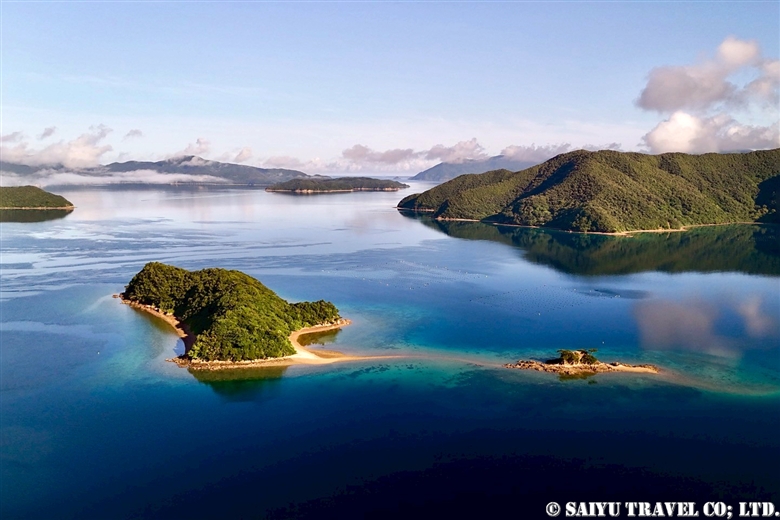
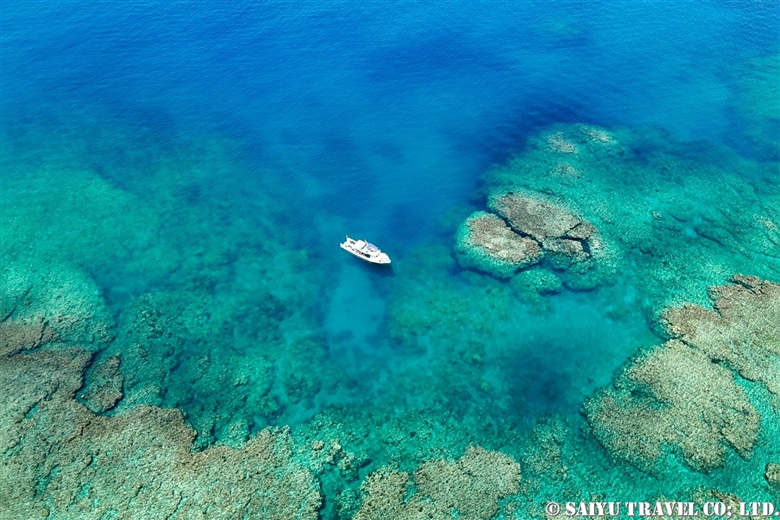
Discover the Magic of Amami Oshima’s Sea Amami Oshima, a UNESCO World Natural Heritage site, is a diver’s paradise. In the southern part of the island lies Setouchi Town, where the Oshima Strait—nestled between the main island and Kakeroma Island—offers breathtaking views of its rias coastline and crystal-clear waters.
Views of the Oshima Strait (Aerial drone shot by AquaDive Kohollo)
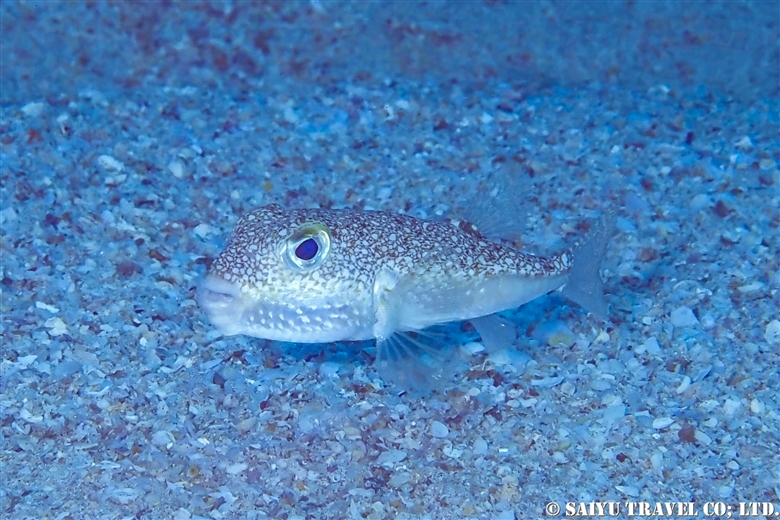
↓↓ Watch: How the White-Spotted Pufferfish creates its Mystery Circle
↓↓ A chance to swim with Indo-Pacific bottlenose dolphins in the Oshima Strait!
The Mystery of the Deep
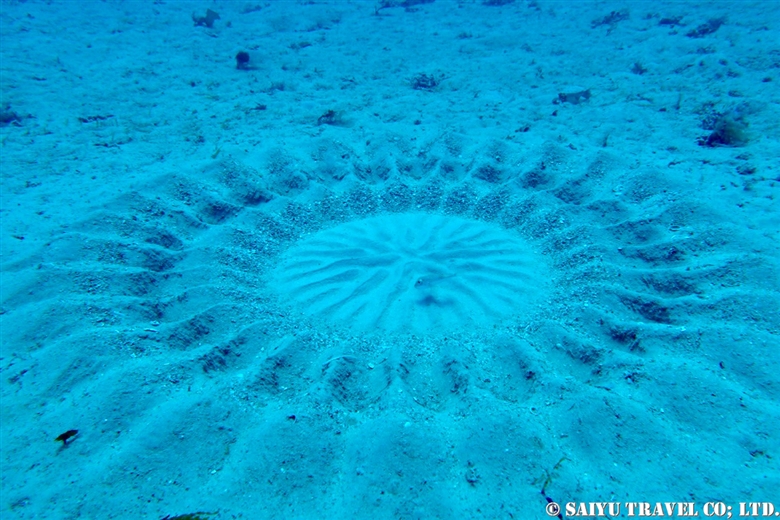
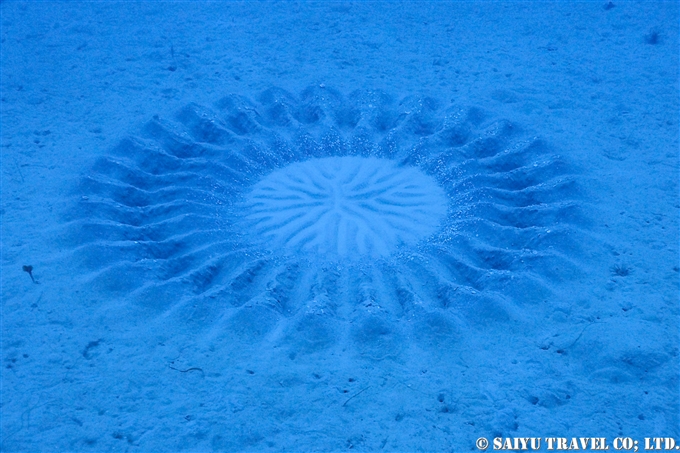
Since around 1995, mysterious geometric patterns, about 2 meters in diameter, were discovered on the sandy seabed of Amami. These became known as “Mystery Circles,” and for 16 years, no one knew who created them.
The ‘Mystery Circles’ of the seabed that remained a puzzle for many years
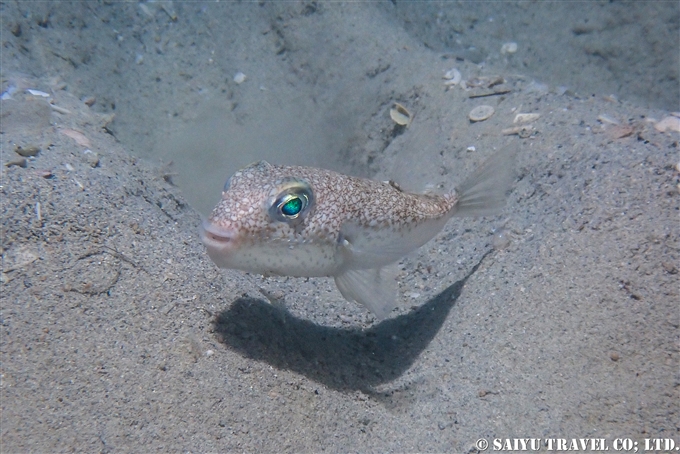
It wasn’t until 2011 that underwater photographer Yoji Okata finally caught the artist on camera: a tiny pufferfish! In 2014, it was officially named the White-Spotted Pufferfish (Japanese name: Amami-no-Hoshizora-Fugu).
Later, it was discovered that these pufferfish live not only in the southern part of Amami Oshima, but also along the northeastern coast of Kakeroma Island and in the sandy depths of Kasari Bay in the north, at around 30 meters deep.
Japanese name : Amami-no-Hoshizora-Fugu アマミノホシゾラフグ
The name Hoshizora means “Starry Sky.” It comes from the beautiful white spots on the pufferfish’s back, which look just like the glittering stars in the clear night sky over Amami Oshima.
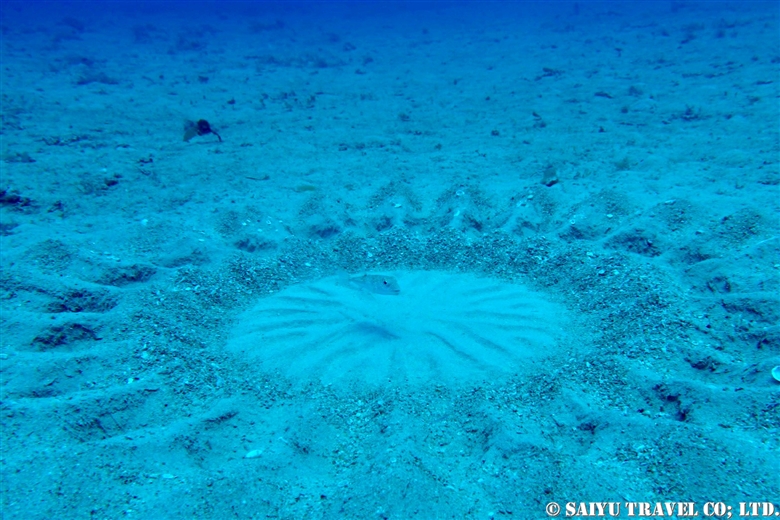
These Mystery Circles are actually spawning nests built by the males. Despite being only 10-15cm long, the male spends 7 to 9 days working without rest to dig grooves and create ridges using its fins. The more perfect the circle, the more likely he is to attract a mate!
When a female arrives, a unique ritual begins: the male gently bites the female’s cheek. This stimulates her to lay eggs and keeps her steady in the center of the nest. Once the eggs are laid, the devoted father stays for about a week to protect them and fan them with fresh seawater until they hatch.
Observing the Pufferfish (Photography by AquaDive Kohollo)
On our diving tours, you can observe the entire process, starting from the circle-making itself. If you’re lucky, you might even witness a female arriving or a male devotedly caring for the eggs. However, please note that these mystery circles are usually found at depths of around 30 meters, making observations difficult if they are located any deeper.
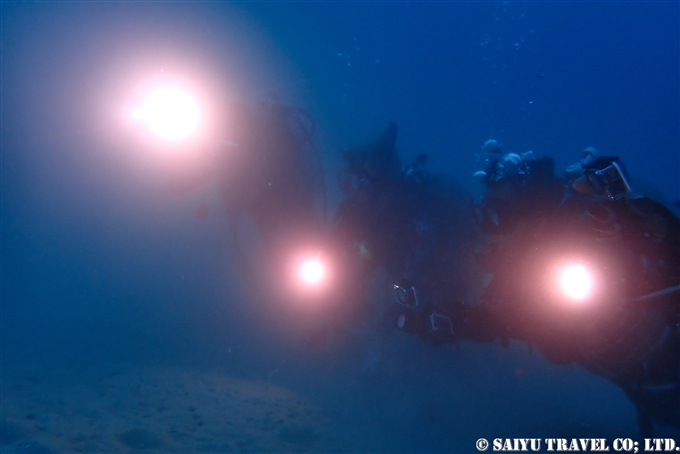
When observing, we take great care not to disturb the pufferfish or kick up any sand. While using a strobe is currently permitted, there may be restrictions on the use of continuous lights. Please be sure to follow the specific rules set by local diving association.
More to Explore
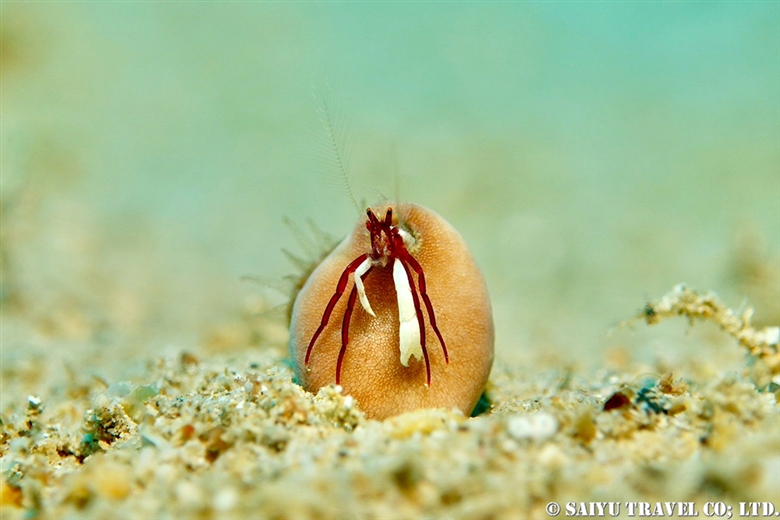
The Oshima Strait is a treasure trove of marine life. Beyond the pufferfish, you might even have the chance to swim with Indo-Pacific bottlenose dolphins! You can also find rare creatures like the Sutsubo-sando-yadokari (a hermit crab discovered in 2017) and the colorful Boxer Crab.
This hermit crab, called Sutsubo-sando-yadokari, was only just described as a new species in 2017. What makes it truly unique is that it carries and walks around in a ‘living coral’ instead of a shell.
Sutsubo-sando-yadokari (a hermit crab discovered in 2017) (Photography by AquaDive Kohollo)
It is a tiny hermit crab, characterized by its vibrant red legs and white claws peeking out from the coral.
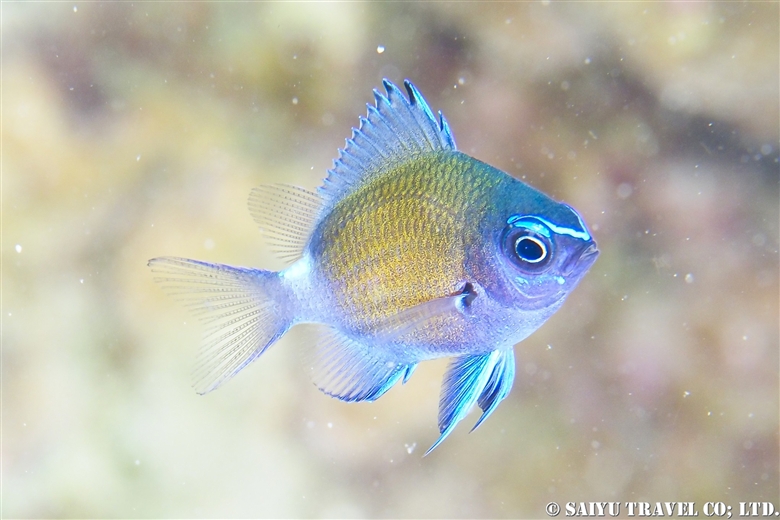
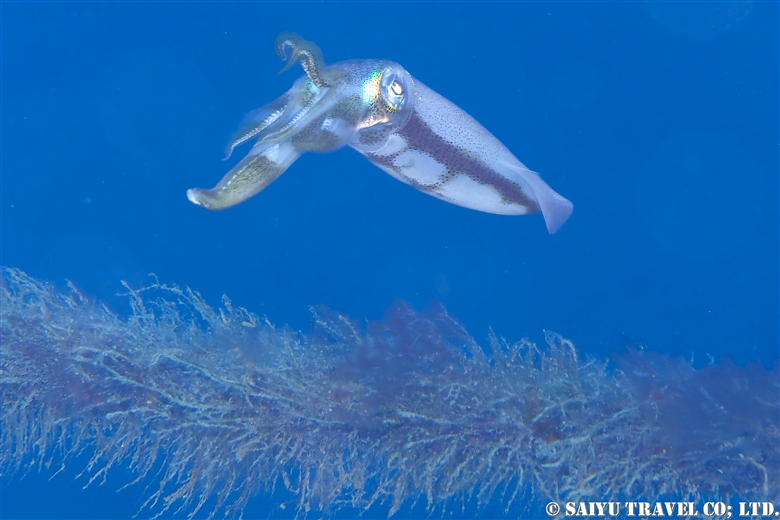
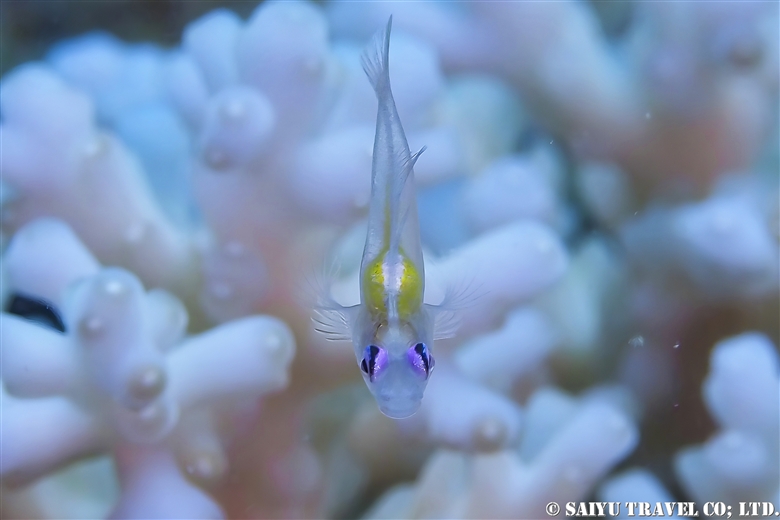
The beautiful waters of the Oshima Strait in southern Amami Oshima (Aerial drone shot by AquaDive Kohollo)A lucky find: The adorable Boxer CrabYoung Amami DamselfishA juvenile Bigfin Reef Squid approaching the boatRed-eye GobySurrounded by a fun-loving diving team (Photography by AquaDive Kohollo)
If you’re looking for a diving experience filled with wonder and natural art, come and see the Mystery Circles of Amami Oshima!
There are two subspecies of the Ryukyu Robin (Akahige in Japanese): Larvivora komadori komadoriwhich inhabits Amami Oshima Island, and Larvivora komadori namiyei which is found on the main island of Okinawa. These are two species that are considered a subspecies at the moment, but I heard that an announcement to make them two separate species will occur in the near future.
This is a report about a 5 day, 4 night tour conducted in early April.
Day 1 Starts from the main island of Okinawa. First we stop by the Triangle Pond (Sankaku-ike) , a famous birding spot. The usual Eurasian spoonbill (Herasagi) was seen amongst the flock of the usual flock of Black-faced spoonbills (Kurotsura herasagi).
Black-faced spoonbill Photography by Hiroshi KAWADA
We saw Black-winged Stilts (Seitaka shigi) here and there, and Greenshanks (Aoashi shigi) flying by. In the distance, Temminick’s sStint (Ojiro tounen) and a Long-toed Stint (Hibari shigi) are present. On the power lines, the Light-vented Bulbul (Shirogashira) and the Jungle Crow (Ryukyu hashibuto garasu, Corvus macrorhynchos connectens) were calling loudly.
From the Triangle Pond, we headed north to the Yanbaru Area. We waited for the Ryukyu robin (Akahige, Larvivora komadori namiyei) and the Okinawa rail (Yanbaru kuina). We could hear the Ashy minivet (Ryukyu sanshoukui,Pericrocotus divaricatus tegimae), and the Warbling white-eye (Ryukyu mejiro, Zosterops japonicus loochooensis), but we did not hear a sound from the target species. The day was completed after confirming the call of the Yanbaru Rail.
Day 2. A chilly morning, for Okinawa. We set out in the early morning, before sunrise, to see the Yanbaru Rail. We were able to see two rails crossing the road, as well as 4 Ryukyu wild boar.
After breakfast, we went to Akahige Point. Before I could see anything else, an Okinawa woodpecker (Noguchigera) flew to the dead tree right in front of us! We were so lucky! It seems like they were nest building, and we could hear the knocking sounds “kon-kon, kon-kon” coming from inside the hole…In order to prevent disturbing them, we kept our distance and observation time short.
Okinawa woodpecker Photography by Yuji TSUKAMOTO
The Ryukyu robin was the main attraction, but it didn’t make an appearance for a while. But there was one participant saw a male and female, and even captured some photos of it bathing.
Ryukyu Robin, Larvivora komadori namiyei (male) Photography by Hiroshi KAWADABathing Larvivora komadori namiyei (male) Photography by Hiroshi KAWADA
After eating lunch, we went to photograph the Pacific swallow (Ryukyu tsubame), perched along the roadside. Other tourists who saw the scene of us gathered around asking “What is that?” After I answered them, they pulled out their cell phones also and started to snap photos as well! (Lol).
Pacific swallow Photography by Hiroshi KAWADA
After that, we went to the nearby rice field in search of shorebirds and other waders. Unfortunately, the area had changed so much, that it no longer seemed like a place for the shorebirds to hang out.
In the morning, some people had missed the Red-winged woodpecker and Okinawa woodpecker, so we headed back to that point. Sadly, however, we could not see much and ended up running out of daylight.
Day 3 This is the last day of the tour on the main island of Okinawa. However, we did not have much time, so we started from before dawn to look again for the Okinawa Rail. We waited in a certain spot for a long time, but they did not appear there. I did, however see some on the road several times.
After breakfast, we only had one hour. At Akahige Point, we managed to see one individual male. We also got a good look at the Ashy minivet (Ryukyu sanshoukui, Pericrocotus divaricatus tegimae.
Ryukyu Robin Komadori komadori namiyei (male) Photography by Kayo TSUKAMOTOAshy Minivet Pericrocotus divaricatus tegimae Photography by Hiroshi KAWADA
We arrived at Naha Airport to head to Amami Oshima. Although it was a little chilly in Yanbaru, it was so hot in Naha! Our plane took off heading to Amami Oshima.
It was windy in Amami Oshima, so we gave up on birdwatching along the coast, and went for a walk through the forest sanctuary instead. While we didn’t have much time there, and the sky looked suspicious as well, we got to see the White-backed Woodpecker (Ooaka gera, Dendrocopos leucotos owstoni). And we were really hoping to see a White’s Thrush subspecies, the Amami Thrush (Ootoratsugumi, Zoothera dauma major). However all we saw was the Amami Jay (Rurikakesu), and then we were out of time.
After checking into the hotel and we had finished our dinner, we set out for a nightwalk. Accompanied by a local guide, we drove along the forested roads. As a result, we could see many Amami woodcocks (Amami Yamashigi) and the Amami Rabbits (Amami Kurousagi). Also, we could see endemic species such as the Amami Woodcock, Amami Rabbit, Amami Ishikawa’s frog (Amami Ishikawa gaeru), Okinawa pit viper (Himehabu), and the Amami spiny rat (Amami togenezumi),making it a very special night.
Amami Woodcock Photography by Hiroshi KAWADAAmami Rabbit Photography by Yuji TSUKAMOTOAmami Ishikawa’s frog Photography by Kayo TSUKAMOTORyukyu scops owl Photography by Hiroshi KAWADA
Day 4 We were a bit worried about the weather, but we set out in search of Amami thrush, Amami jay, and other thrushes. Unfortunately, we had a little rain, on and off. We broke the participants up into two search groups, one for searching for the Ryukyu robin, and one searching for the Amami thrush. The Ryukyu robin group could end up seeing a few. The Ryukyu thrush group, could see one, but no one could catch a photo of it.
Then, after lunch, we split up into two groups again, and we were all able to see the target species and get photos of them both, fortunately. We also had some good opportunities to photograph the Ryukyu jay.
Ryukyu Robin Larvivora komadori komadori Male)Photography by Yuji TSUKAMOTORyukyu Robin Larvivora komadori komadori (Female)Photography by Kayo TSUKAMOTOAmami Thrush Photography by Hiroshi KAWADAAmami Jay Photography by Yuji TSUKAMOTO
Day 5 Last day of the tour. The weather forecast is not looking good. Unfortunately it looks like rain until the end of the tour.
First, we set off before dawn to listen to the calls of the Ryukyu thrush. On the way, we saw an Amami woodcock and heard the calls of a Ryukyu scops owl. As we parked the car, we had a light rain, but we could hear the calls of the Ryukyu thrush.
After breakfast, we didn’t have much time. But it would have been nice just to see the White-backed woodpecker (Austin Ooakagera), so we searched for it on the way to the airport, but we could not spot it. Finally, we went to a rice paddy, where some migratory birds, might be around. Despite the rain, we were able to see the White-Breasted Waterhen (Shirohara kuina) and the White Wagtail (Houjiro hakusekirei, Motacilla alba leucopsis), the Black-winged Stilt (Seitaka shigi) and other species.
White-Breasted Waterhen Photography by Hiroshi KAWADAWhite Wagtail Motacilla alba leucopsis Photography by Hiroshi KAWADA
This tour was a hyper-focused tour just for the hardcore birders, with the aim of seeing both subspecies of the Ryukyu robin on the main island of Okinawa and on Amami Oshima, and I can say it was a success. I wish to thank all the participants, who made the most of their precious time, over the course of 5 days, to intensely help search for birds, from early morning until late at night.
Text : Kenji YANAGAWA – Bird concierge
Photos are courtesy of all the participants of the tour
Observed: Beginning of April, 2023, Okinawa main island, and Amami Oshima
*Contact us, Saiyu Travel for more information about wildlife and bird watching in Okinawa & Amami Oshima. We can make various arrangements for your trip.
There were two tours conducted in December 2022. This is the first tour report that took place Dec 12-16, 2022. Reported by bird guide, Yoshinori Toshitake.
Day 1
We gathered at Kagoshima Airport and headed to Izumi by private car. We arrived at Izumi in the afternoon and started looking for the cranes. First, I saw the Sandhill Cranes, but it was far away on this day, so I decided to look for the Common Crane and a Siberian Crane, while of course observing and photographing the White-naped Cranes and the Hooded Cranes.
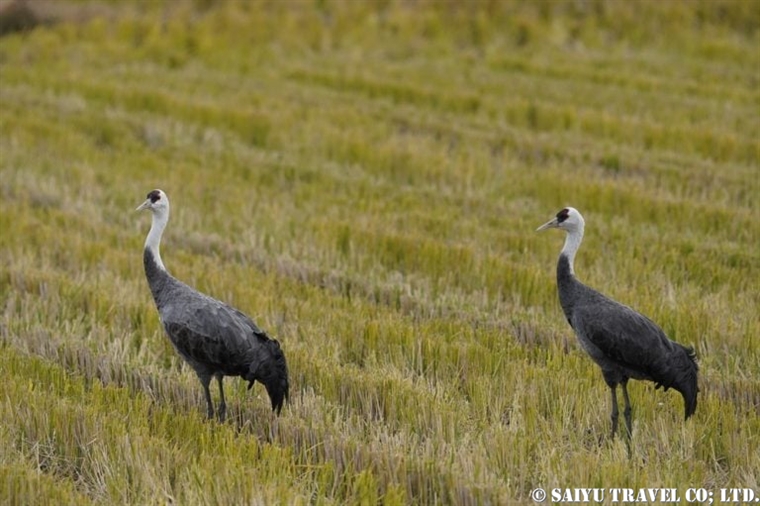
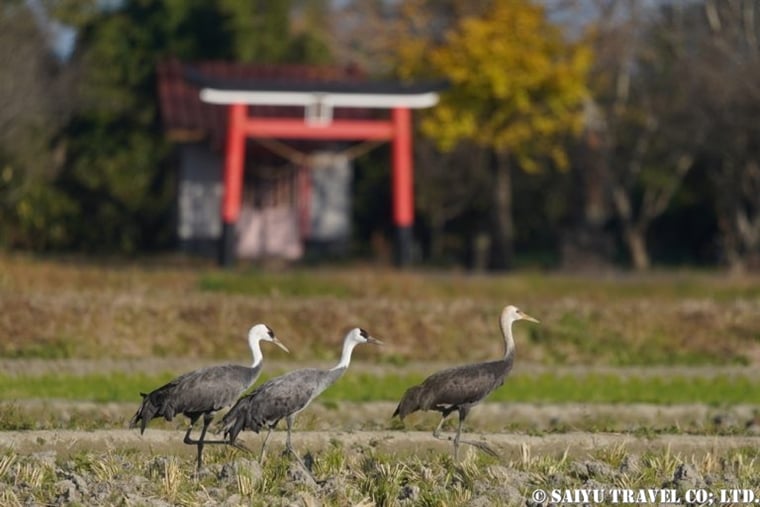
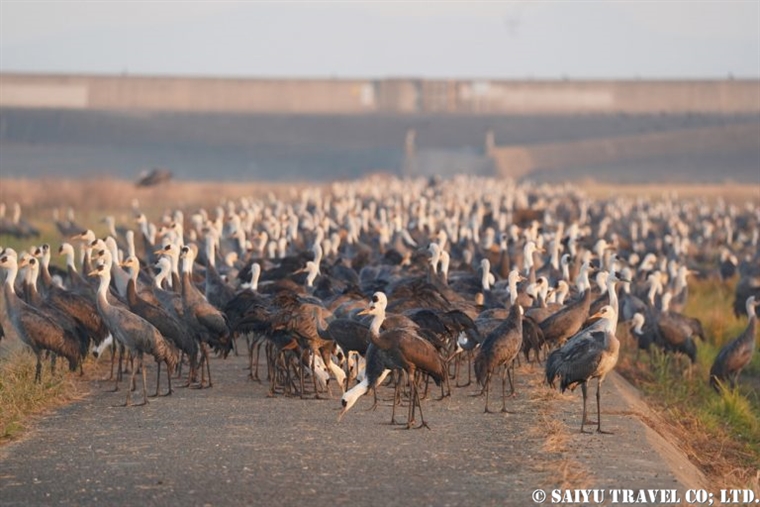
A family of White-naped Cranes drinking waterForaging Hooded Cranes
Day 2
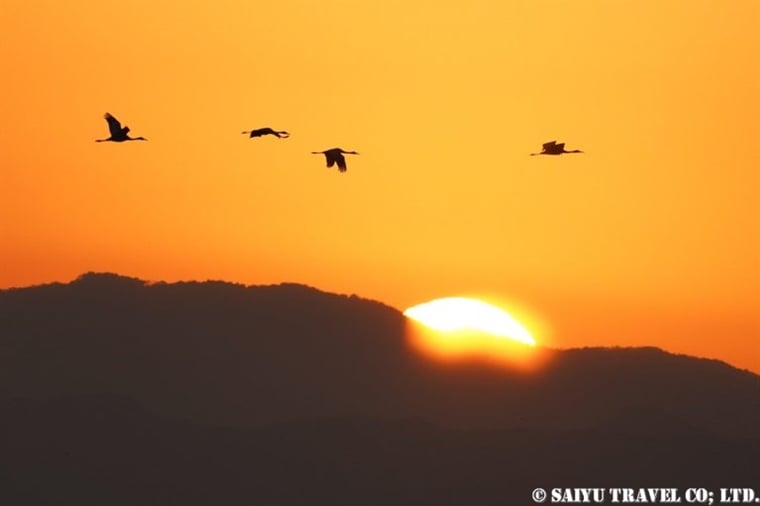
We arrived at the reclaimed land while it was still dark, and first observed the sunrise and cranes. The cranes flying in against the backdrop of the sunrise was beautiful, and the participants were engrossed in getting their photos of the scene.
Sunrise and the cranesThe Cranes as they forage
After the sunrise, I was aiming to see the Daurian Jackdaw, which was perched on the electric wires. On this day, I could see the white-colored one, known as “Shiromaru.”
Rook(Right) and Daurian Jackdaw (two birds on the left)
After that, while I was watching cranes from the roof of the Observation Center, I found some Black Cranes hiding in the shadows of the road. I waited patiently, moved to a position where I might see the whole body of the cranes without the other cranes blocking it. This year, the number of cranes is a bit less than normal, but it is all a matter of timing if you can see them or not.
A Black Crane
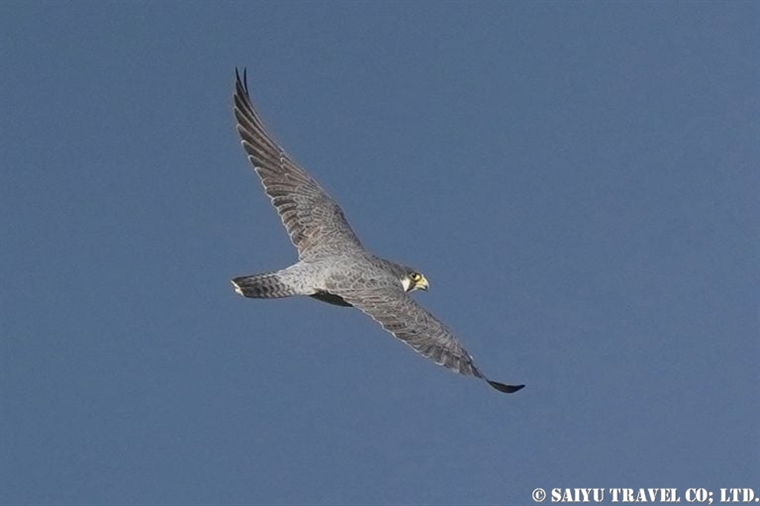
While I was waiting for this crane to come out from the flock, a Perigrine Falcon also appeared, and the ducks that were foraging in the farmland got pretty riled up by it.
The Peregrine Falcon
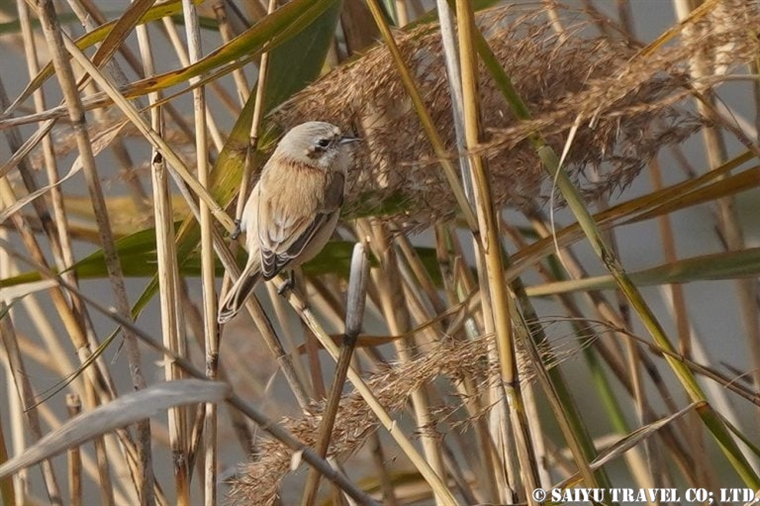
Then, we tool a walk along the river, where we aimed to find the European Peduline Tit and the Chestnut-eared Bunting. We could first, hear the calls of the tit, out on the reed bed, but they appeared pretty close by eventually. It is a very small bird, but it didn’t sing at all while observing it, so it took quite a while for everyone to be able to spot it.
Eurasian Penduline Tit
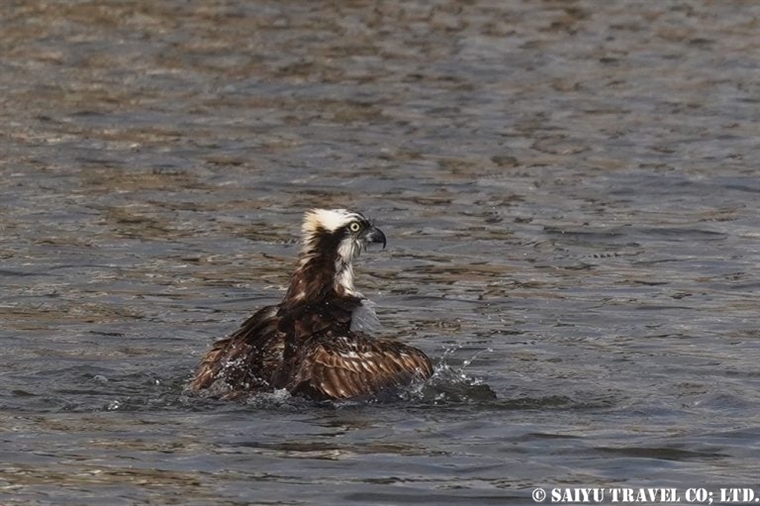
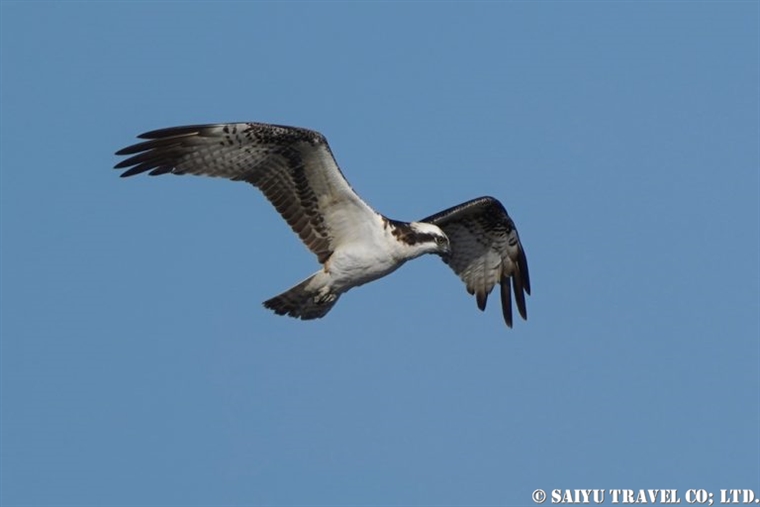
The Chestnut-eared Buntings were perched on the concrete embankment, and an Osprey was observed bathing in the river. Ospreys are often only seen in flight, so it is quite rare to see them in the water.
A bathing Osprey
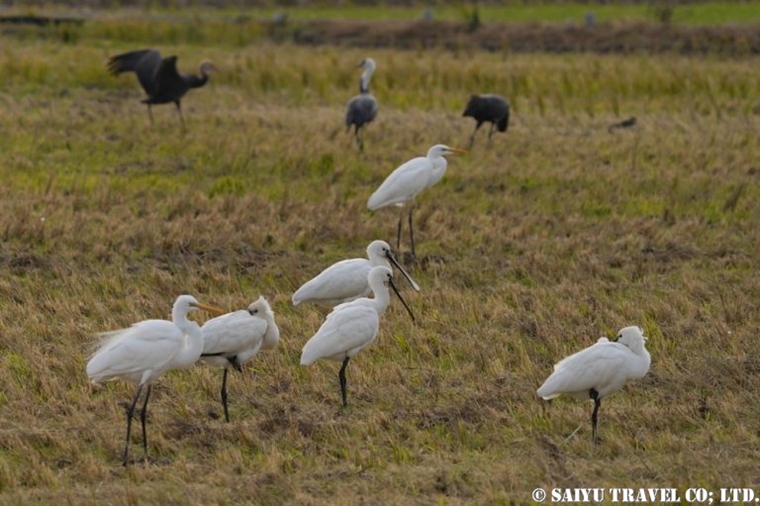
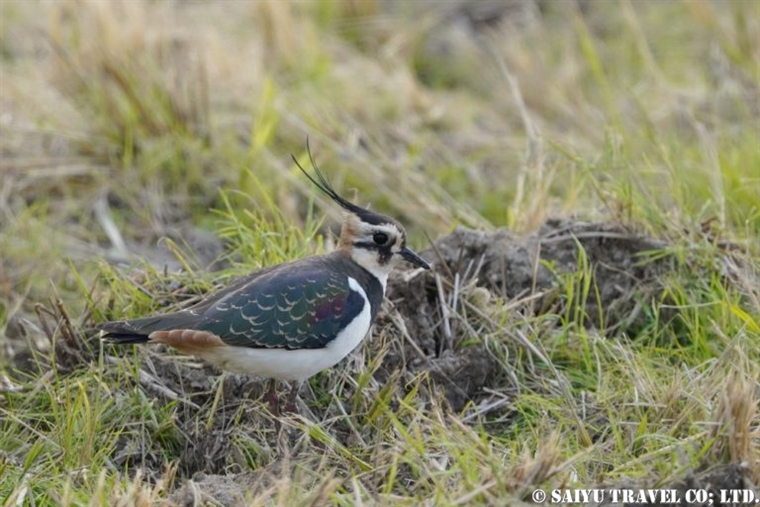
In the afternoon, we went into the mountains and looked at the dam and along mountain streams. The Mandarin Duck were still very cautiously avoiding us, and the Mallards, Eurasian Wigeons, and Common Pochards were seen in the water near the dam. While I was scanning for Mandarin Ducks in the darker areas of the edges of the water, I saw a Mountainhawk Eagle gliding, for just a moment. And as I approached the area of the Crested Kingfisher, I found one perched on some driftwood. The kingfisher flew away and then landed on a dead tree, so I tried to put it in the scope while informing everyone, but it flew off again immediately. Also, on the way back, when crossing the bridge, I heard the call and saw the flight of the kingfisher. Surprisingly, there were two that flew together in the upstream direction of the river. In the evening, we returned to the reclaimed land and observed Eurasian Spoonbills and Northern Lapwing.
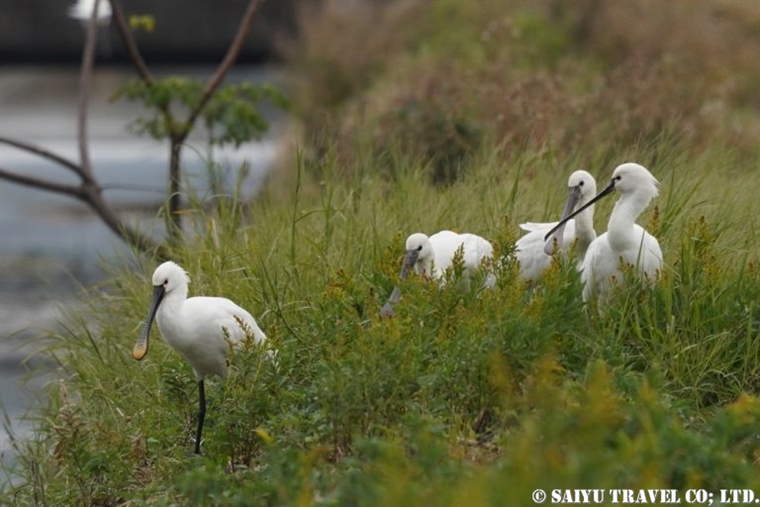
Flock of Eurasian SpoonbillA Northern Lapwing
Day 3
We arrived at the reclaimed land while it was still dark, but unfortunately the clouds were so thick that we could not see the sunrise or the moon. I was waiting in the car, regretfully thinking that it would be useless to try to observe anything, but a Siberian Crane appeared. The Siberian Crane was easy to observe last year, but it was rare to see them this year.
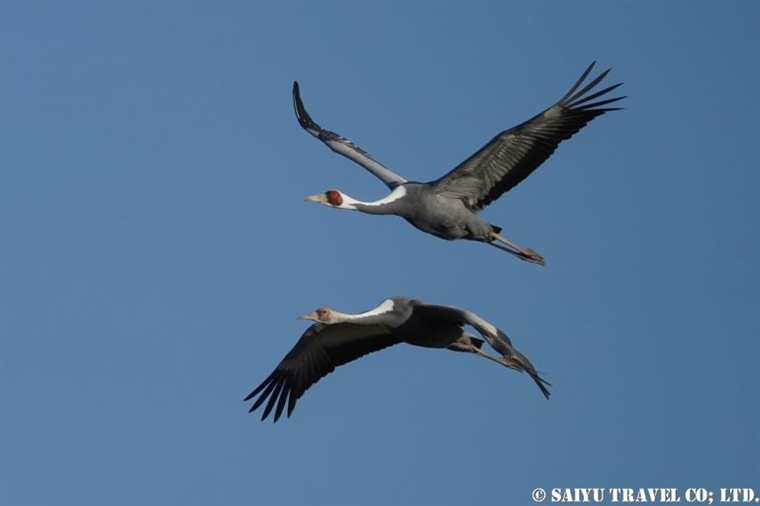
A White-naped Crane (behind) and Siberian Crane (in front)
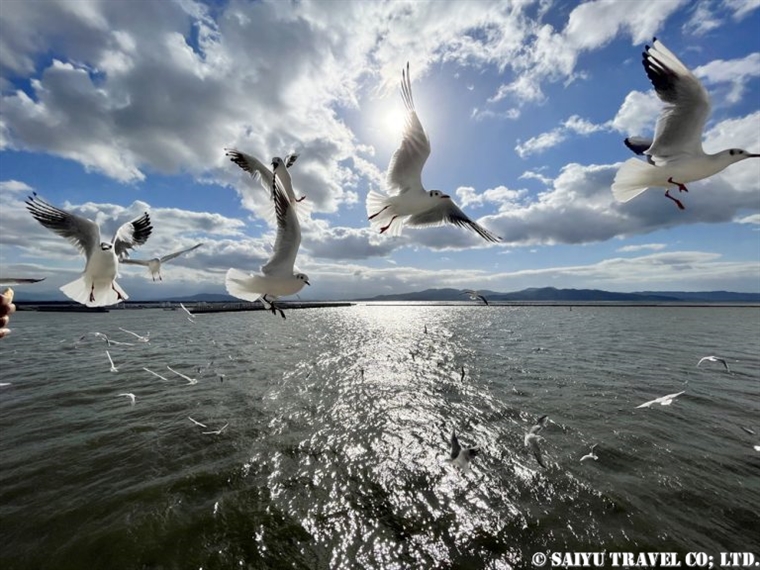
We left Izumi early to catch the ferry before noon and headed to Kumamoto. The ferry heading to Shimabara was bustling with the Black-headed Gulls looking for snacks from the passengers even before our departure. I don’t know how many there were, but after the ship left the port, many of them continued to follow the ship.
The Black-headed Gulls as they follow the ferry
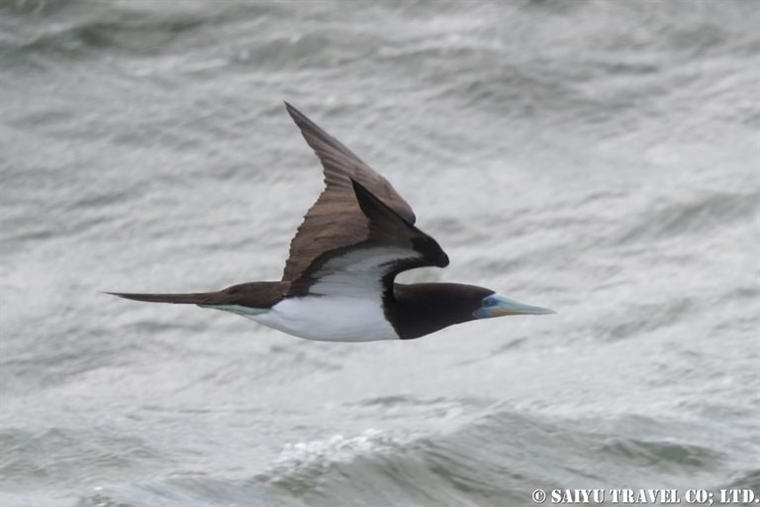
After leaving the port, we observed a large flock of Brown Boobies resting on the embankment, and that day, there were also some flying near our ship.
Brown Booby flying above the waves
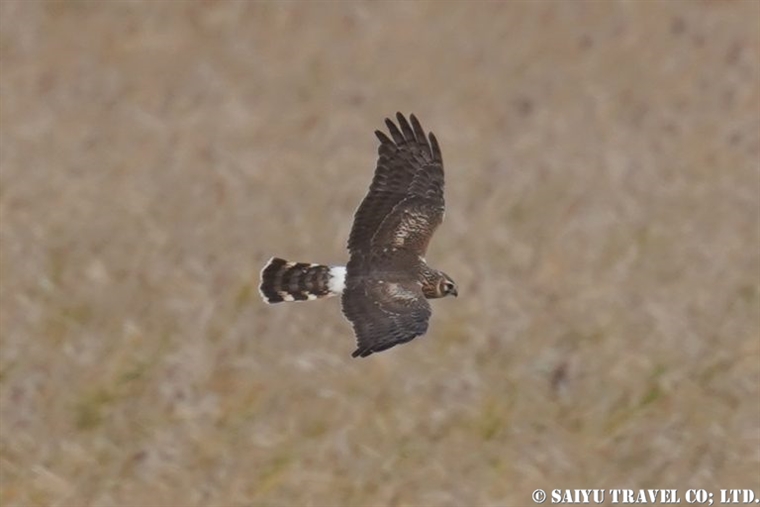
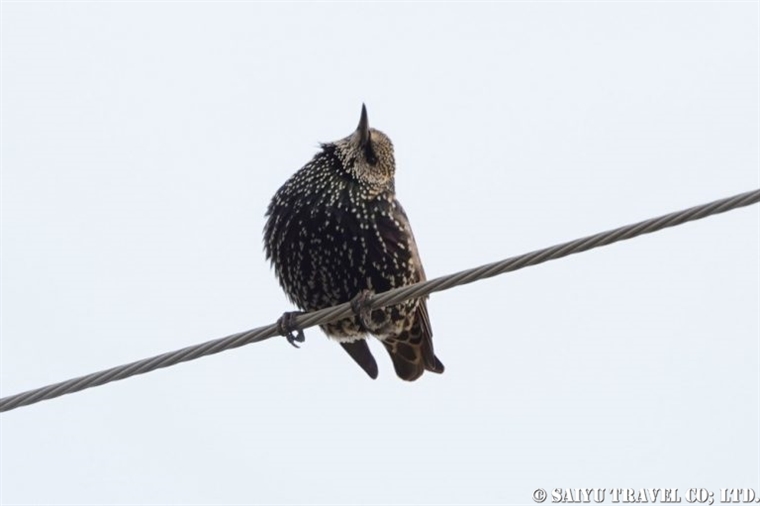
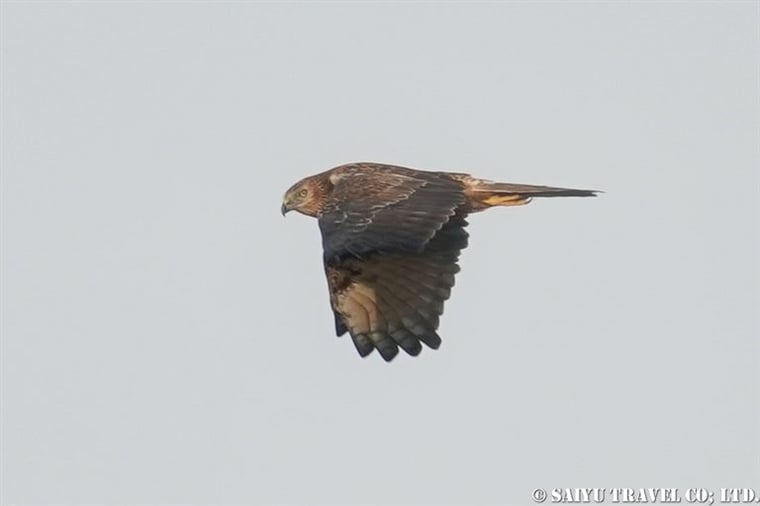
The Isahaya Reclaimed Land has vast cultivated farmlands and reed beds. In the field of reeds, there were various species we observed, such as the Hen Harrier and Common Reed Bunting. The Common Starling and Common Kestrel were seen and photographed in the farmland areas.
A Juvenile Hen HarrierThe Common Starling
Day 4
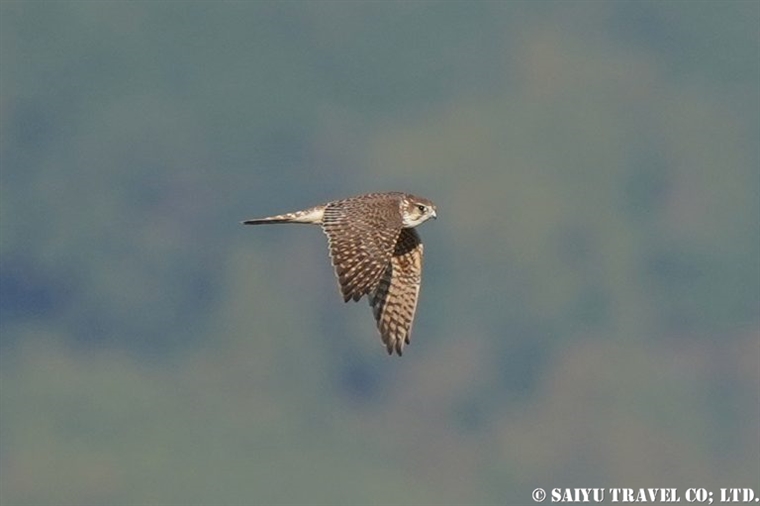
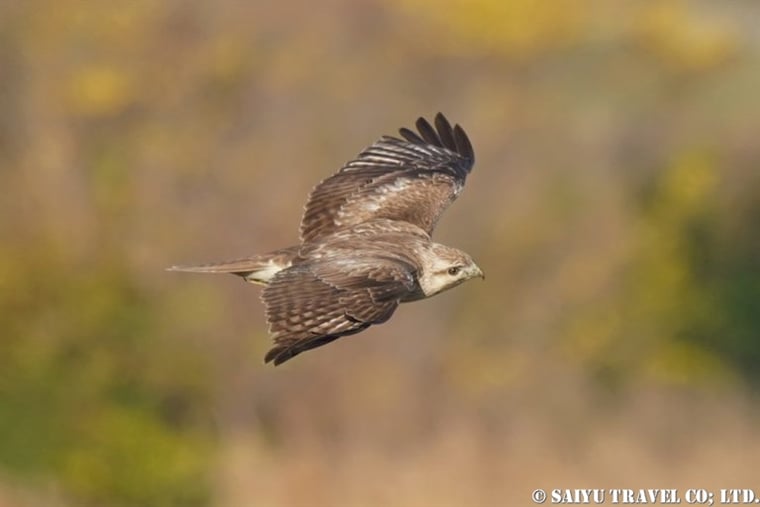
In the morning, we visited the Isahaya reclaimed land again. Birds of prey such as the Common Kestrel and Common Buzzard can be seen around the reed bed. The Merlin was also observed targeting hunting the small birds on the edge of the grass.
Common KestrelEastern Buzzard
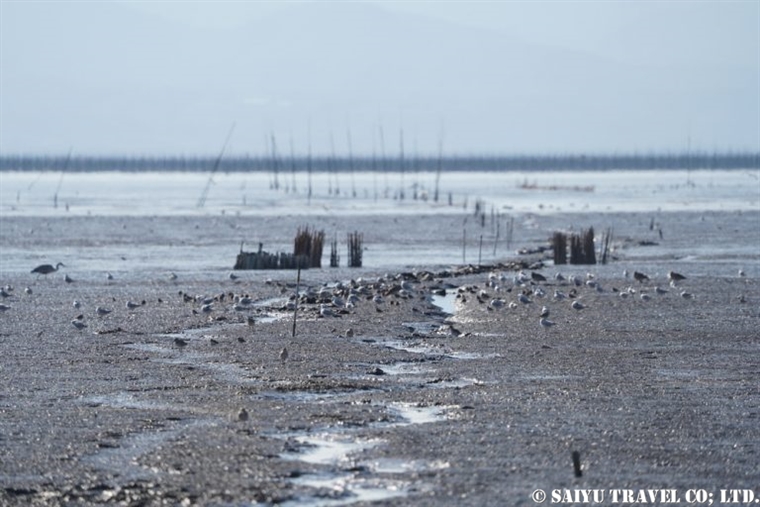
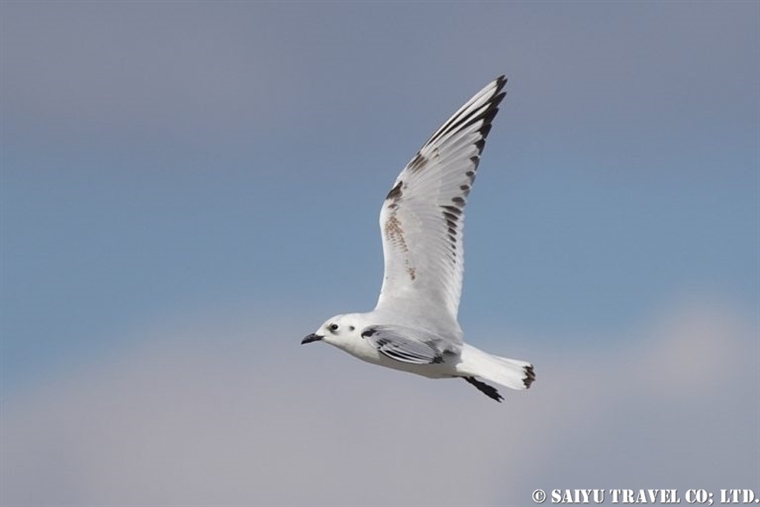
In the afternoon, we moved to Higashiyoka in Saga Prefecture, and observed the mud flats at high tide. On this day, the tide level was much lower than normal even, though it was high tide, and the mud flats were dotted with shorebirds, Common Shelducks, Saunder’s Gulls, and other species of birds.
The mud flats dotted with various shorebirdsSaunder’s Gull
On the way from the mud flats back to the hotel, we found a magpie, which I rarely see anymore. It was observed perched on a powerline, and then on the roofs of the houses.
Day 5
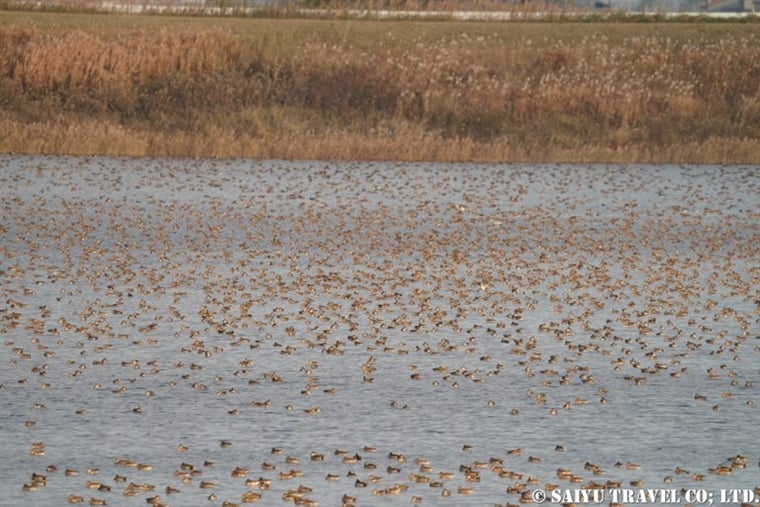
Since we saw the magpie yesterday, I changed the plan and headed to the reservoir first instead. We could see the thousands of Bikal Teal, very alive and well, and the large flocks of them were spread across the open water.
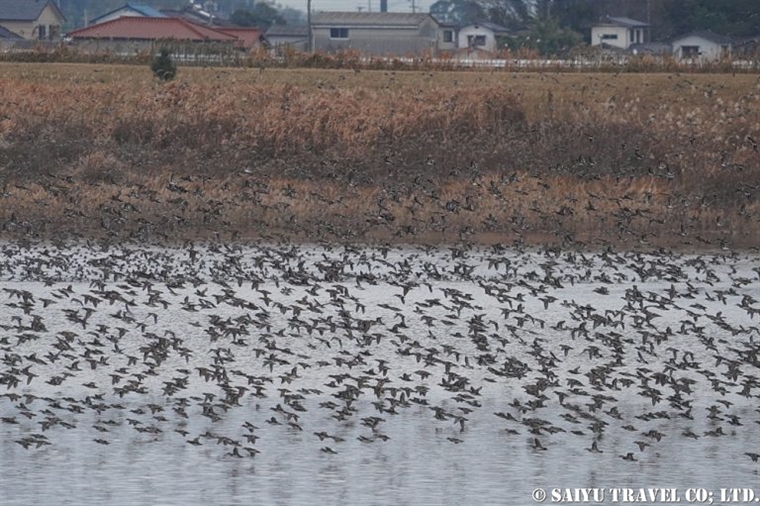
A large flock of Baikal Teal taking flight
Here, we took a walk on a paved road, less than 3km, and enjoyed watching the large flocks of Baikal Teal, as well as being able to see birds of prey, such as the Northern Goshawk and smaller birds, such as the Common Reed Bunting. After that, we went up the river and observed Common Kingfisher, Long-billed Plover, Brown Dipper, etc. in the stream with clear water. Then we headed to Fukuoka Airport, and ended our tour there.
(99 Confirmed Species)
There were two tours conducted in December 2022. This is the first tour report that took place Dec 7-11, 2022. Reported by bird guide, Yoshinori Toshitake
Day 1
We gathered at Fukuoka Airport and headed to the Ariake Sea in a private car. On the way, we had lunch at the service area of the highway, and started birding at the reservoir. Last year there were only a few birds, but this year more than 5,000 Bikal Teal were there. It was an overwhelming amount of birds!
The huge flock of Bikal Teal
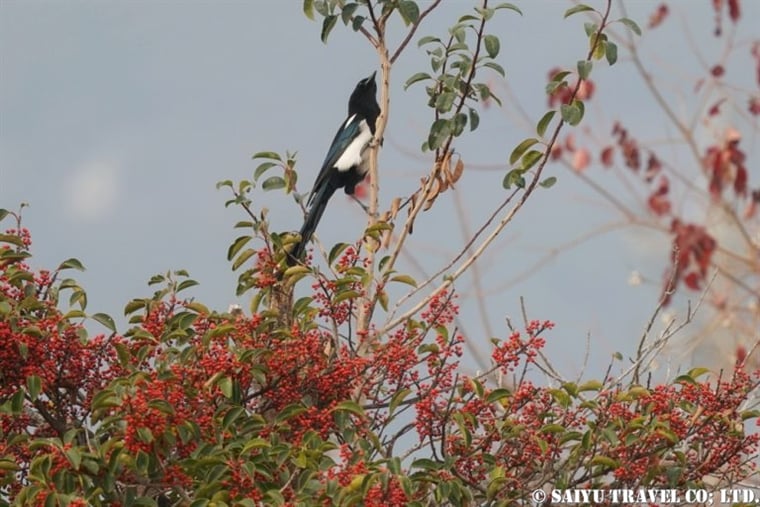
With so many ducks, we were able to enjoy the appearance of birds of prey such as the Hen Harrier and Northern Goshawk. But when returning to the car, I was happy to hear the cry of the Eurasian Magpie. Magpies inhabit Fukuoka, Saga and Nagasaki Prefectures, but especially around Saga, their numbers are declining so there are times when I can’t even see them. So carefully, we approached them, and this time could even observe them, luckily. I was able to take photos of the birds catching food on the ground and in the trees.
Magpie foraging for food in the trees
After that, we went to Higashiyoka higata (shoreline), and since it was low tide, we could see the vast tidal flat before heading to the hotel.
Day 2
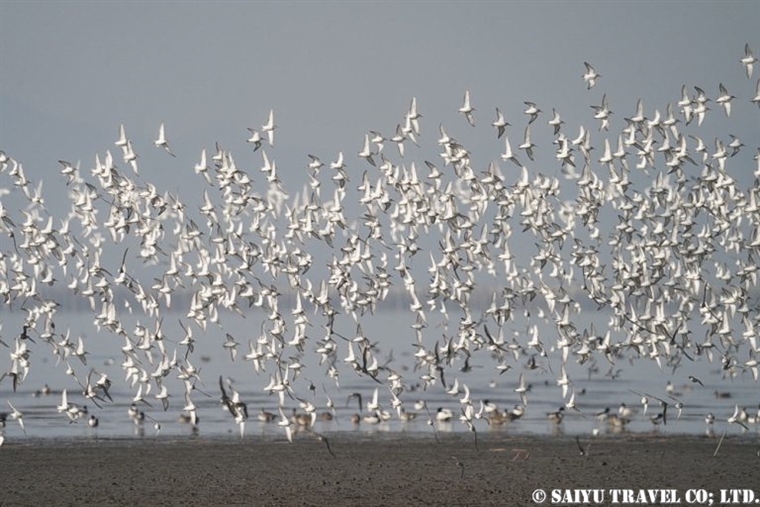
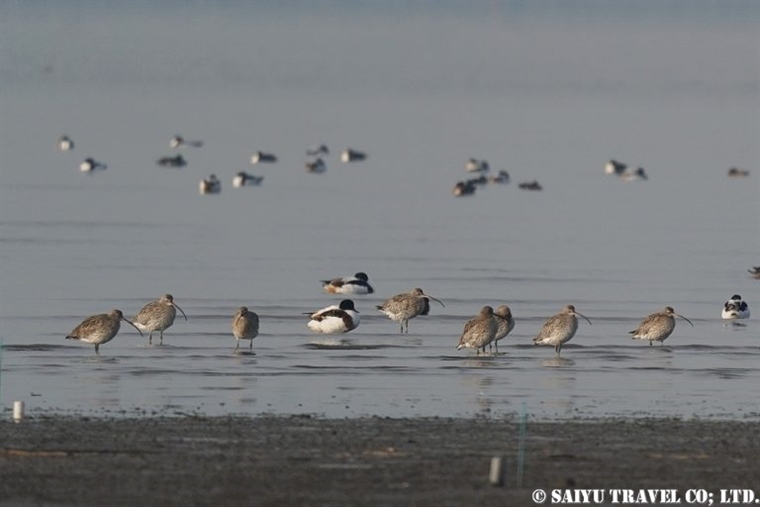
In the morning, we went to the same Higashiyoka tidal flats to observe waterfowl, such as sandpipers and plovers in the high tide. Unlike yesterday, the birds were all so close, and we were enjoying observing the flocks of Dunlin, Eurasian Curlew, Common Redshank, Common Shelduck, Saunder’s Gull, and many other waterfowl. Then, suddenly the flock of Dunlins all took off, all at once. They synchronized their movements, and I enjoyed the murmuration, as they shifted their direction in unison. This is exactly why the Higashiyoka mud flats are a great example of Japanese shorelines, a truly vast and wonderful environment.
A Dunlin flock taking flight all at onceEurasian Curlew and Common Shelduck
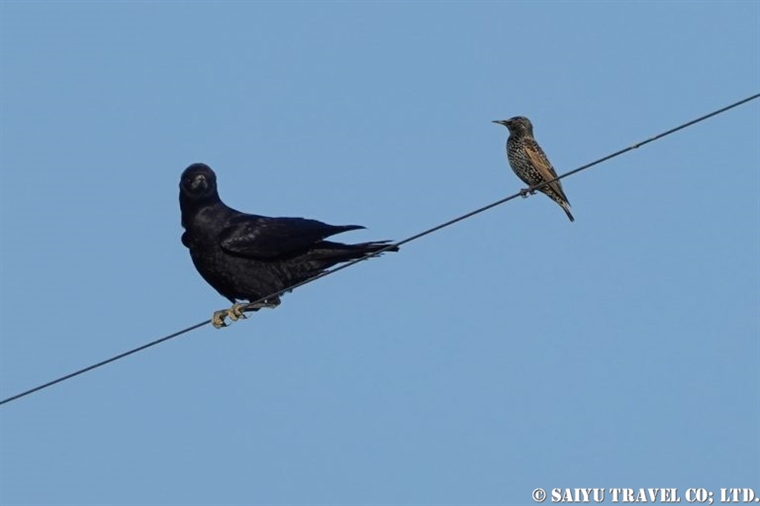
On this day as well, we had lunch on the highway service area, and in the afternoon, we headed to the Isahaya reclaimed land area. In the reed beds, we observed the Hen Harrier, Eastern Marsh Harrier and the Merlin as they were hunting. In the agricultural areas there were Northern Lapwing, Common Starling and Chestnut-eared Bunting, and in the waterways we saw a Green Sandpiper. We also could enjoy seeing some wild mammals, a Japanese racoon dog ‘tanuki’ in the reed beds, and wild boars ‘inoshishi’ in the farmed areas.
The Eastern Marsh HarrierA Rook & Common Starling
Day 3
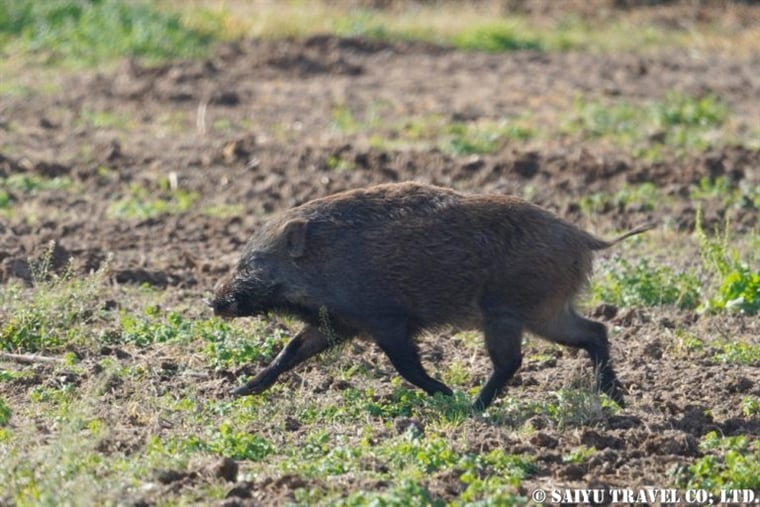
In the morning, we visited the reclaimed land again and observed the Black-winged Stilt, Common Kingfisher and a Common Kestrel. I also saw a wild boar in the farmland area. Yesterday, it was only showing its tail, as it ran away, but today I was able to see it nearby.
The Wild Boar on cultivated land
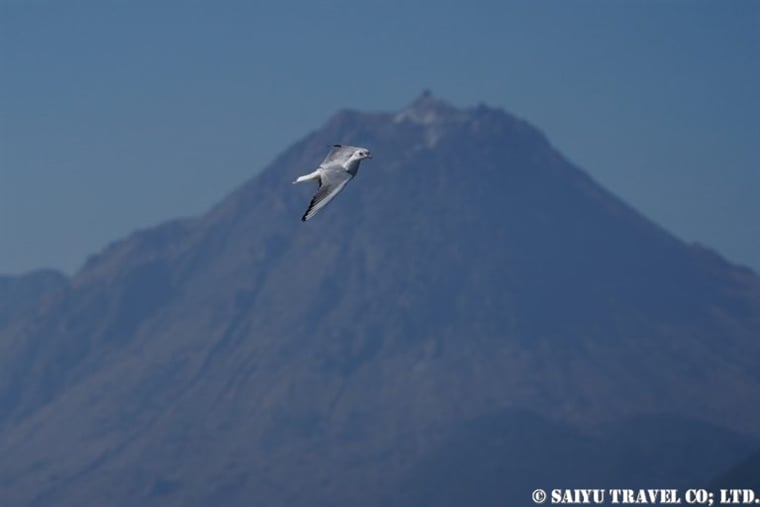
After that, we took a ferry from Shimbara, and watch the birds from the boat. As soon as the boat departed, a flock of Black-headed Gulls, gathered in front of us to catch food thrown by the passengers, and we enjoyed watching them fly around with the beautiful backdrop of Mt. Unzen.
A Black-headed Gull and Mt. Unzen’s Peak
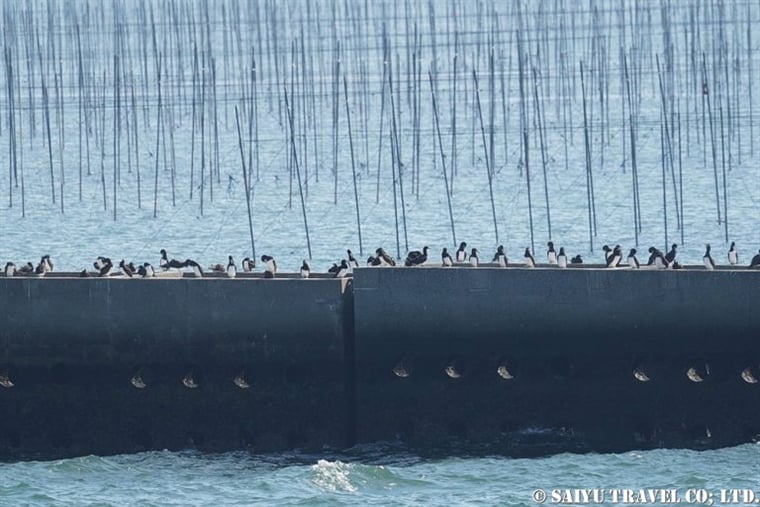
Then, just before entering the port, about 600 Brown Boobies were also observed on the embankment. I was amazed at just how many of them were gathered there.
Brown Boobies resting on the embankment
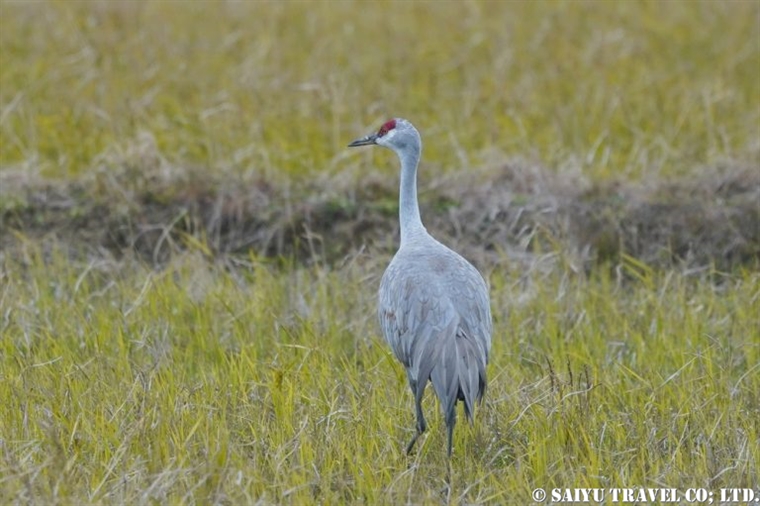
We got off the ferry, went to Izumi, even though it was early in the evening, we observed the cranes on the reclaimed land. Of course we saw the Hooded Cranes and White-naped Cranes, but I was feeling like I was missing something, so I searched hard and found a couple of Sandhill Cranes also mixed into the flock.
A Sandhill Crane
Day 4
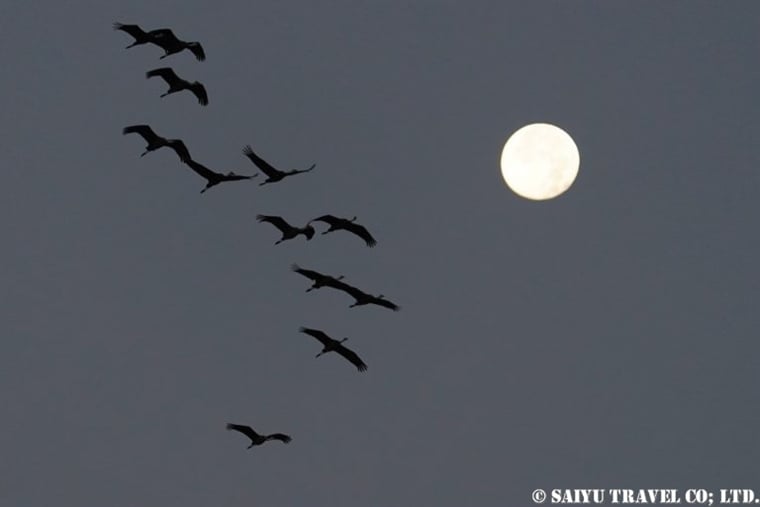
Cranes are most active in the early morning hours, as they are fed in the morning. On this day, we arrived while it was still dark, and aimed at shooting the cranes flying against the backdrop of the sunrise and the moon. We were lucky that the weather was good, and the moon was almost full. While it was still a bit dark, a Short-eared Owl appeared as it was being attacked by a crow.
The moon and the cranesSunrise and the cranes
Once the cranes settled down, my next target to see was the Daurian Jackdaw. Just at this timing, a group of rooks gathered on the electricity wires above and there was a jackdaw mixed in with them as well. I could see the white type of jackdaw (commonly called a Shiromaru), from a distance, so I was able to photograph it capturing the entire body, without any difficulty.
On the left, the Daurian Jackdaw and a Rook
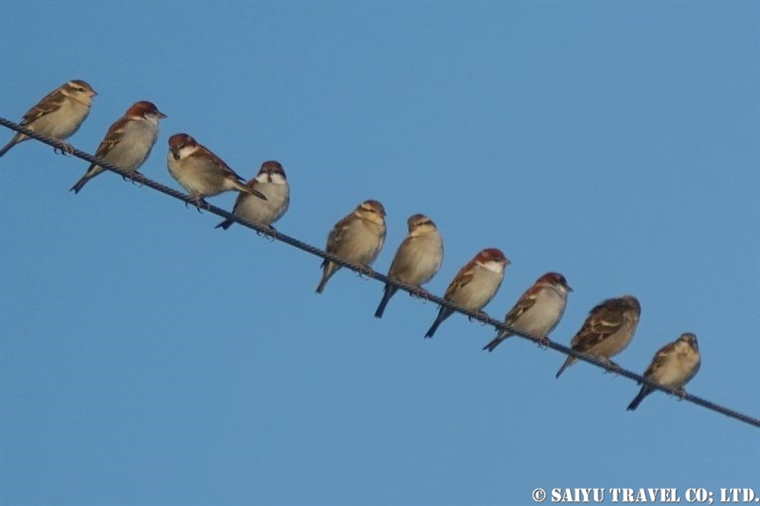
It seems that the sole purpose of this same electric wire is not just to pass electric currents, but to give a flock of Cinnamon Sparrows a perch also. Unlike the common sparrows where both sexes have the same patterns, these Cinnamon (or Russet) Sparrows have different patterns for males and females, making it a very cute bird to watch. After watching them for a while, we tool a walk along the river to aim to see the European Penduline Tit and Chestnut-eared Bunting. Although I could hear their calls, I could only visually confirm it once we returned to the car. Other species seen along the river included the Dunlin, Osprey, Eastern Buzzard and Common Reed Bunting.
The Cinnamon Sparrows
In the afternoon, we headed up the mountains to target the Crested Kingfisher and the Mountainhawk Eagle. We saw Mallards, Eurasion Wigeon, Common Pochard, etc, resting on the open water. The Mandarin Duck, which prefers dark places near the water’s edge, is the most cautious one, so even if we are far away, if it senses we are within a certain range, it will fly away to hide. Unfortunately, we were not able to see the Mountainhawk Eagle or the kingfisher, but we were able to hear the cries of the Eurasian Jay and Japanese Grosbeak. In the evening, we returned to the reclaimed land to observe the White-naped Cranes and Hooded Cranes for a while.
An OspreyWhite-naped CranesHooded Crane
Day 5
This morning, again, we arrived at the reclaimed land before dawn and observed the cranes into the morning. On this day, the moon was hidden by the clouds, and the sunrise was different from yesterday, so we could experience the daily changes of the weather. There were fewer cranes this year, but the density of the foraging in the morning is quite impressive. They started eating the food scattered far away and gradually approached us.
The scene during the morning foraging
After returning to the hotel and checking out after breakfast, we observed the cranes some more and saw some Eurasian spoonbills on the reclaimed land. Izumi is a famous wintering ground for the cranes, but there are also many other species of birds. The Eurasian Spoonbills are astonishing as they sit right next to the road or forage in the three-sided channel.
The urasian Spoonbills
After enjoying, the birds of Izumi until the very last minute, we headed to Kagoshima Airport, where we ended the trip. There were fewer cranes this year, due to the influence of bird flu, but I was able to enjoy the smaller birds and raptors, besides the cranes. It was a photography-focused tour, but Kyushu in the winter has a lot to photograph, and I think everyone who participated, took a lot of photos.
(99 Confirmed Species)
This is a report of a diving trip in Amami Oshima in May. The main focus of this trip was for observing the white-spotted pufferfish, Torquigener albomaculosus. Ten of the 15 dives were to witness the process of circle-making pufferfish, and the remaining 5 dives were planned for seeing the other spectacular creatures of Amami.
This is the season for broadclub cuttlefish spawning. Originally, I was planning to observe the broadclub cuttlefish but this year their numbers was so small that we could not see group spawning that typically happens. Behind the Porites cylindrica are some broadclub cuttlefish eggs. You can see the baby inside, it’s still so very small.
コブシメの体色変化 color change of Broadclub cuttlefish
The amazing ability of the broadclub cuttlefish to change colors is interesting. When I get too close to it, it expresses its bad mood and turned black, but after I moved off a little, it started to mimic the surrounding, lol!
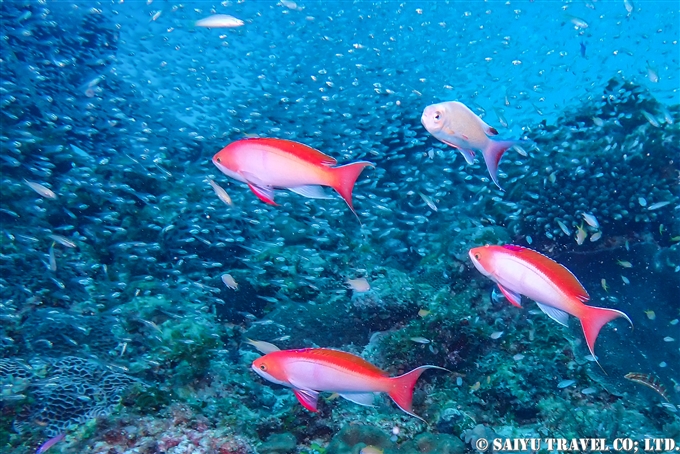
Swimming male Red Fairy Anthias Pseudanthias cooperi, which were at the bottom of a sandy area. The school of Luminous cardinalfish, Rhabdamia gracilis so beautifully swimming and framing the background.
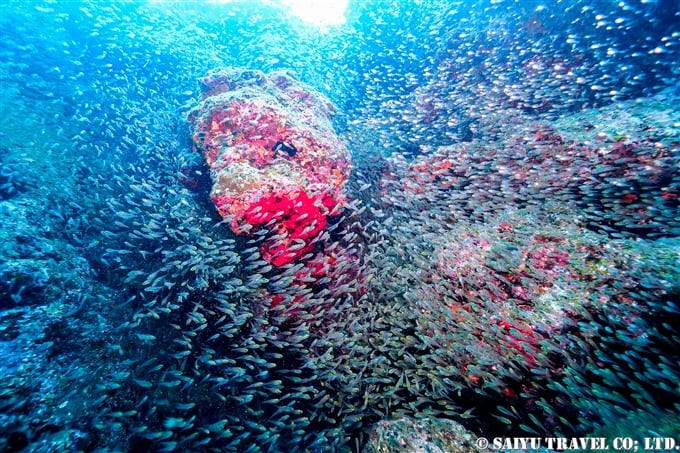
Right at the edge of the reef, a big school of Golden sweepers, Parapriacanthus ransonneti.
Photography by Chizuko MURATA
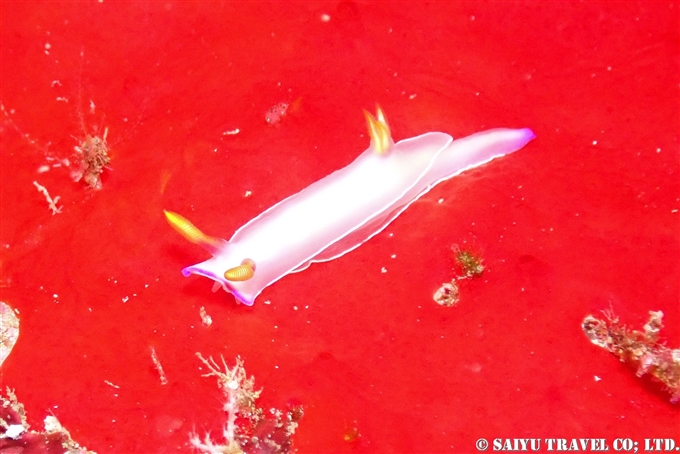
I photographed the nudibranch Hypselodoris bullockii on a red sponge. It looks like a pattern on a Japanese traditional cloth.
Photography by Chizuko MURATA
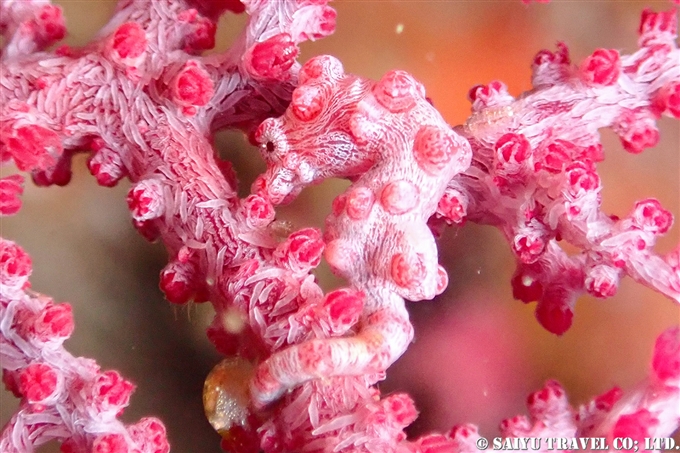
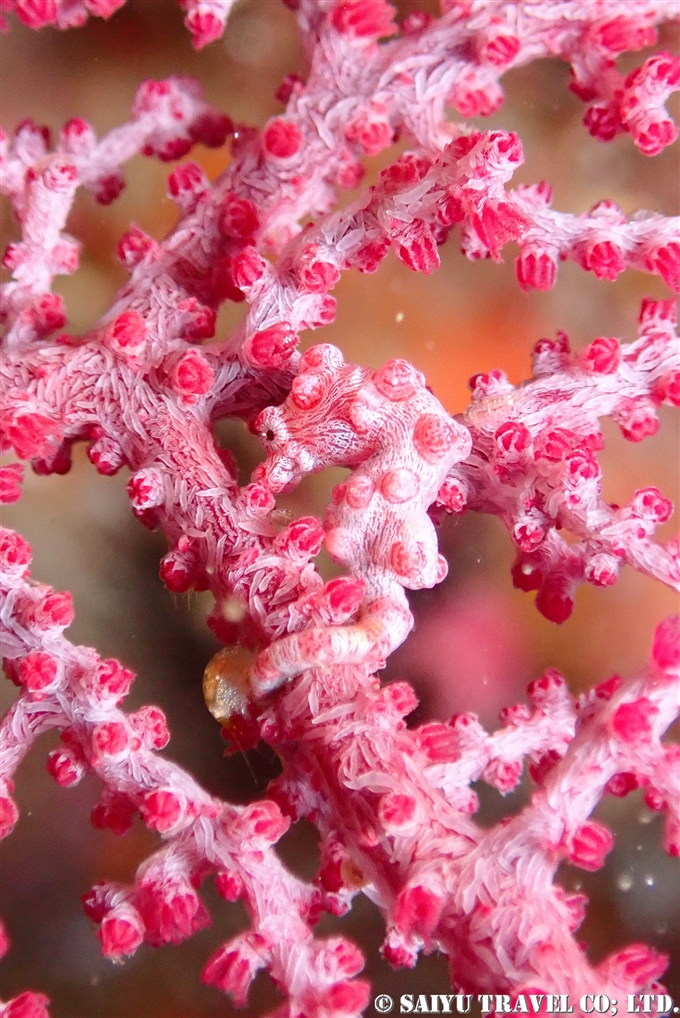
One of the highlights of this diving spot is that we can see pygmy seahorse, Hippocampus bargibanti at a shallow depth of 15m. This pygmy seahorse, which attaches to the red or yellow soft coral. It will mimic with amazing accuracy and becomes the same color as the coral, even mimicking the polyps. When it was first pointed out to me in Ogasawara, I could not even see it, but now, after several opportunities to see it, over and over again, I have gotten just a little better at spotting it.
And this is the “Great Buddha” Coral. It is a large common coral group called Pavona clavus.
The Amethyst anthias, Pseudanthias pascalus schooling above the coral.
The breeding colors of an Amethyst anthias male with a yellow tail
ハナゴイ乱舞 Purple queen wild dance(Videography by Chizuko MURATA)
It was so spectacular to see the little Amethyst anthias, which looked like falling rain at times.
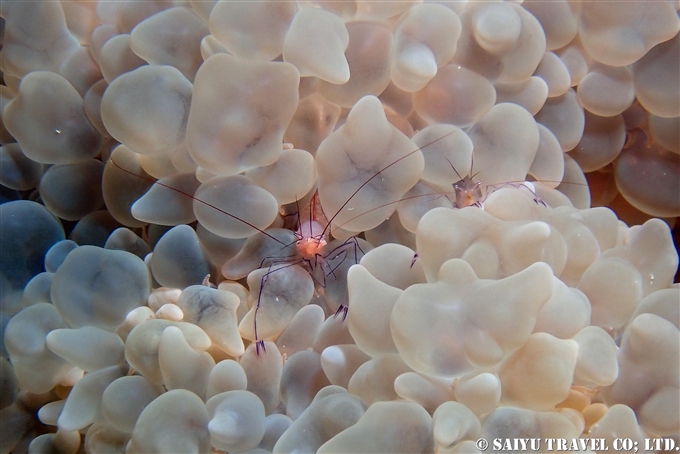
The Bubble coral shrimp Vir philippinensis. It was holding an egg.
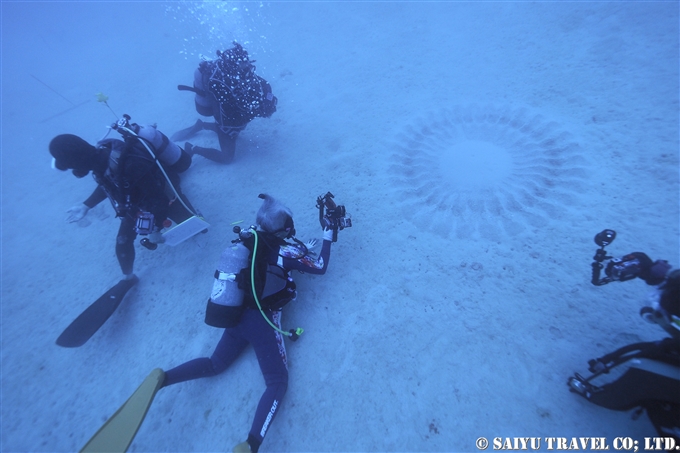
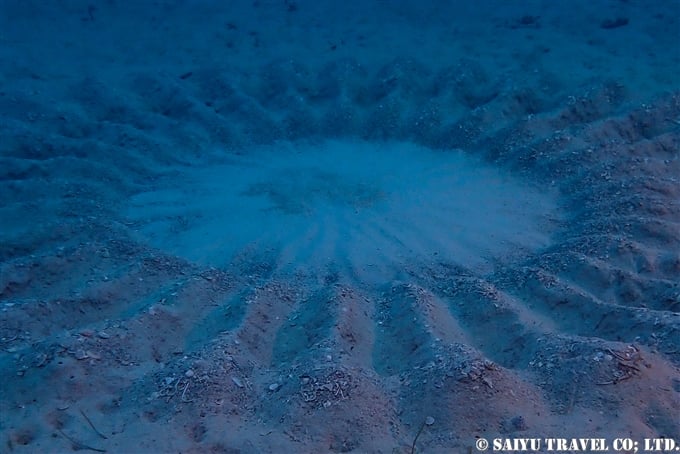
And the highlight of this tour, is the observation of the white-spotted pufferfish circles. The ocean bottom is a fine sand, and you have to be very careful about not messing it up. After staying a while, it will become cloudy.
A rainy day with poor water clarity, looks like this. Because of the depth and the risk of having bad visibility, those who want to observe the pufferfish closely, should make sure they have multiple diving chances.
Putting the finishing touches on the pufferfish’s circle.
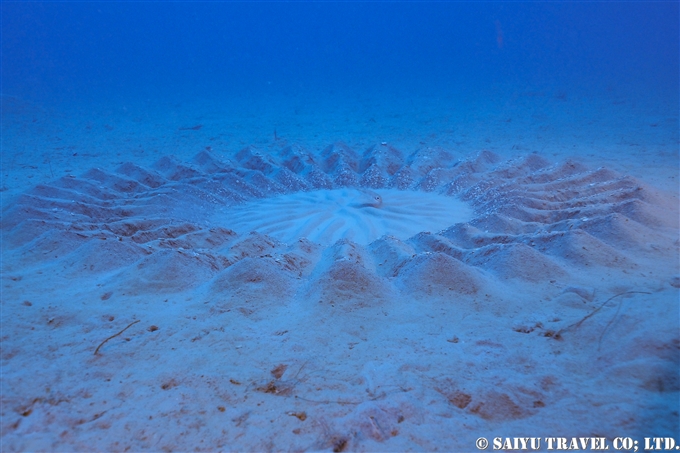
This is the completed circle. For these small fish to do all the work using their bodies, who work on the circle and don’t seem to look at it from above, it is quite an impressive feat.
Now, it is just about attracting the female. This is the diligent male white-spotted pufferfish.
The next day, in the center of the circle where the eggs were laid (the gray mass in the middle). After this, the male will take care of the eggs and the circle will no longer be maintained.
I stayed at Amami Oshima for 6 consecutive nights, and I was really looking forward to the daily meals. Every day is a glorious feast! Octopus, cuttlefish, yellowfin tuna, other seabream species, green turban, … the list goes on!
It was rainy season in Amami Oshima, but during this diving tour we made sure to plan a way to enjoy the ocean and the bounty of food it provides. Thank you to everyone who joined the tour, to our underwater guide-Dive Species Amami, Mr and Mrs. Suwa!
Images & Text: Mariko SAWADA
Some photographs and video: Chizuko MURATA
Observation: May 2022, Amami-Oshima
Special Thanks: Dive Species Amami, Mr. Homare SUWA
These “Mysterious Underwater Circles” of Amami Oshima became a hot topic when a TV program introducing them was broadcasted. Originally found by an underwater photographer in 1995, he didn’t know who made them and for what purpose they were there. It was in 2011, that we finally discovered that it was made by small pufferfish.
The Amami Oshima’s “Mysterious Underwater Circle” is often made nearly 30m deep, so it is hard to observe for long at that depth; and the seasons and tides limit the divers’ abilities to observe these circles, so it took 16 years before we were able to meet its creator, the pufferfish.
This is the male pufferfish, Torquigener albomaculosus, the creator of the circle. In 2014, this pufferfish was registered as a new species. The Japanese name “Amami Hoshizorafugu” is named so because of the dotted pattern on its back, like the many stars in the beautiful night sky of Amami Oshima. (In Japanese “Hoshizora”= starlit night sky, “fugu” = pufferfish)
We observed this white-spotted pufferfish over five days, as it was constructing the circle. In this photo, the pufferfish is decorating the outer edge of the circle with shells. It seems that the fish shapes the shell by chewing on a larger shell in its mouth.
The first step in creating the circle, is for the pufferfish to choose a spot that it likes and begin by removing and seaweed from the area. Then it will make a groove which will be the basis of the circle. For the making of the outer circle, the groove is formed by the small fish using its pectoral fins to roll up the sand moving from side to side. Slowly, the sand is piled up on both sides to form a deeper groove.
The center of the circle, where the eggs will be laid, is made into a gentle shallow area using its stomach.
White-spotted pufferfish which has finally finished making its circle. But even then, it’s very busy with maintenance to keep the shape.
Now it is just a waiting game, until a female pufferfish comes by and likes his circle!
At this time in May 2022, during high tide there were seven circles in the diving area. This morning, one male had success as there were some eggs in the middle of the circle! The gray color mass in the middle of the photo are the eggs.
As soon as the female lays the eggs, she disappears and the male will take care of the eggs in his circle. He will consistently move the eggs and sand with its fins and continue to send them fresh seawater.
A male white-spotted pufferfish who is busy taking care of his eggs. The maintenance of the circle stops and therefore the shape is starting to collapse a little.
So, in this 30m deep area where we were diving, we could see 6 of the 7 circles had eggs. But the one that had no eggs yet, which we nicknamed “Fuguta,” this was the circle that I thought was “the most beautiful and splendid circle” but sadly, it wasn’t chosen by a female pufferfish. I am sure there is a difference between the pufferfish and our senses, but even so, I was disappointed that it was not selected…it was like a Japanese saying that “it was the crowd favorite, but it failed to qualify for the finals.”
Our little “Fuguta,” who was dedicated to the maintenance of his circle. He was laboring over it, however, he wasn’t as energetic as yesterday.
“Fuguta” would not give up! The breeding season will continue for another two months. I left the seabed praying for him, that he’ll be able to attract another female during the next high tide.
Of the 15 dives over a 5 day period, 10 dives were spent observing the white-spotted pufferfish. We observed all the various stages from circle construction, the maintenance, and then of taking care of the eggs. It looks a very smart fish.
Photos & text: Mariko SAWADA
Observation: May 2022, Amami Oshima
Special Thanks: Dive Species Amami, Mr. Homare SUWA
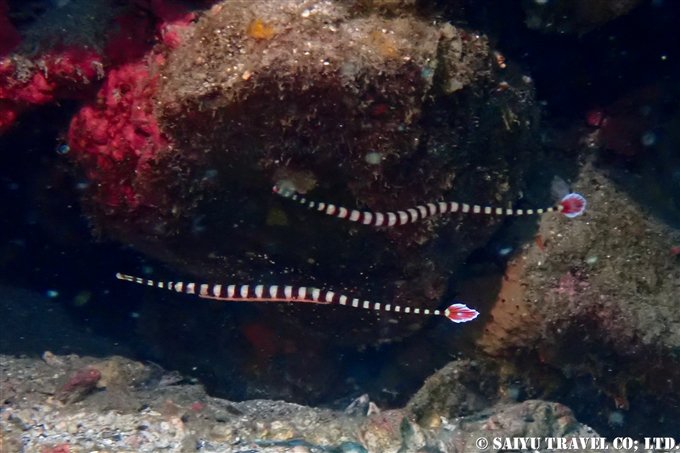
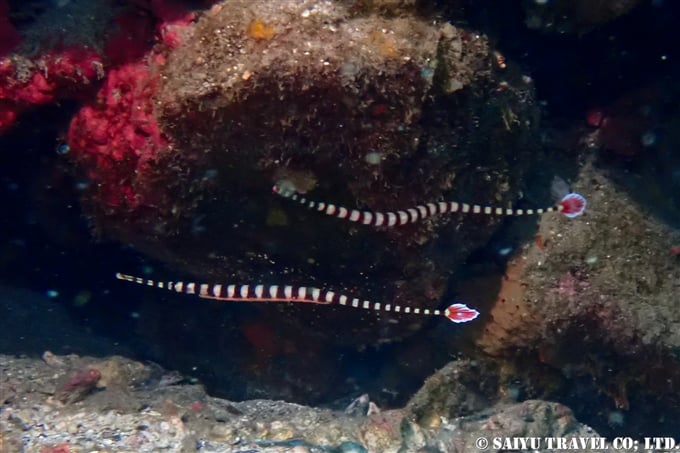
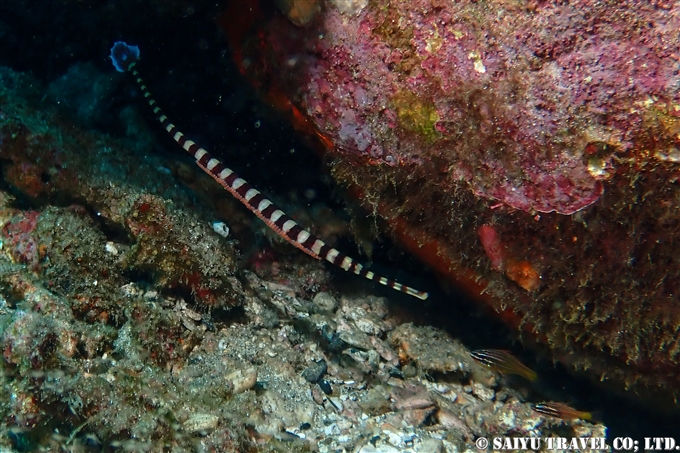
We observed this pair of Banded pipefish in Yakushima’s Isso bay. The pipefish have a white body with many reddish-brown horizontal stripes that cover it from the mouth to the tail fin. The gorgeous tail fin reminds me of the beautiful “Oiran” that Japanese high-ranking courtesans use.
オイランヨウジのペア(屋久島)A Pair of Ringed pipefish
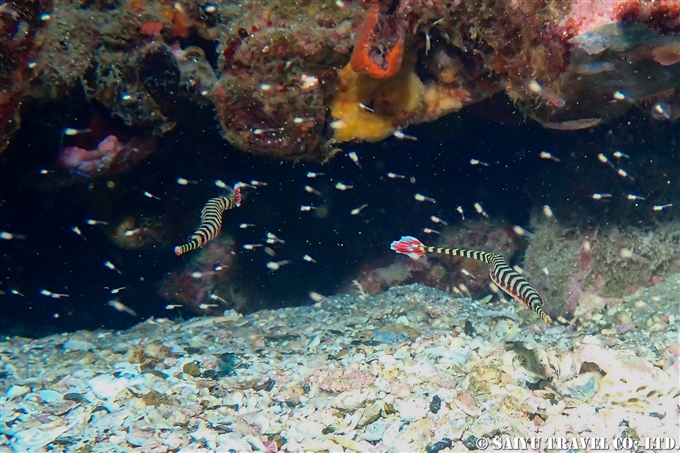
The male banded pipefish has a pouch that incubates the eggs. There can be up to 100 eggs which hatch after about 10 days. The fries are about 6mm when they emerge.
Banded pipefish eat zooplankton. The entrance to this pair’s rock crevice was surrounded by little tiny fries and they were busy feeding on them.
Image & text: Mariko SAWADA
Observation: Jun 2021, Yakushima, Kagoshima
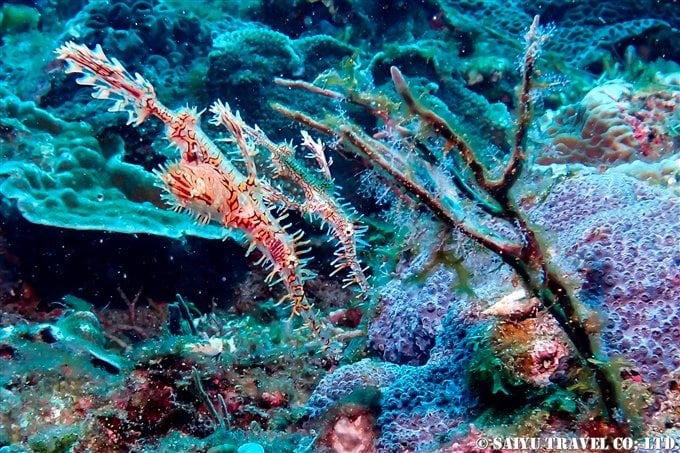
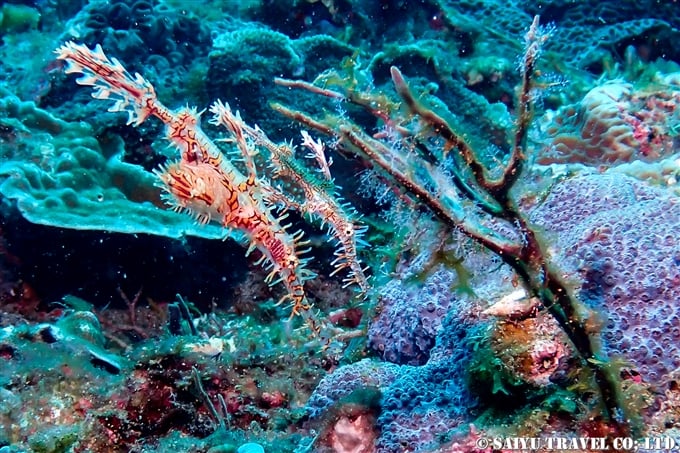
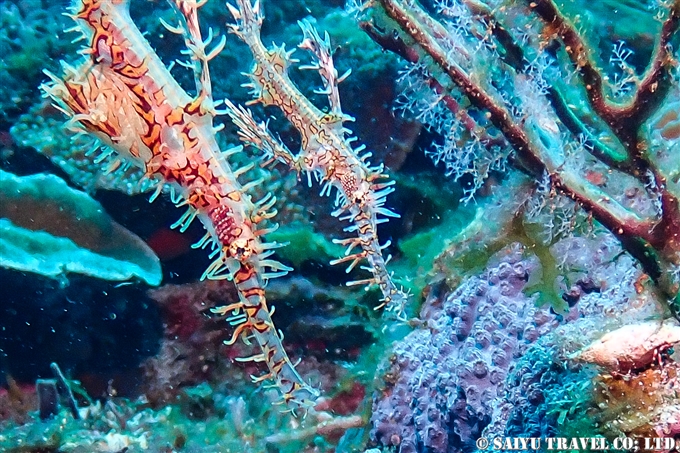
We could see a pair of Harlequin ghost pipefish (Solenostomus paradoxus) in the seas around Yakushima. The pair were in perfect unison with their mimicry, which made it both astounding and beautiful to watch.
ニシキフウライウオのペア(屋久島)A pair of Harlequin ghost pipefish
Harlequin ghost pipefish is a member of the family Solenostomidae. The Solenostomus were previously thought to be an intraspecific mutation within Solenostomidae but, they became an independent species in 1994.
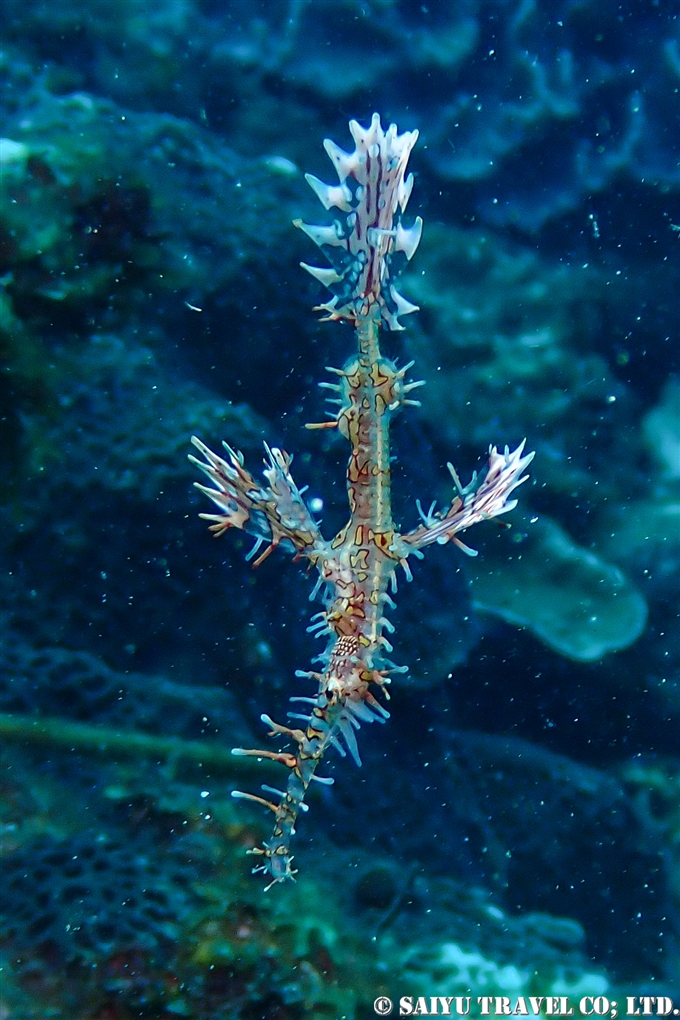
On every part of the body and along its fins, there are spikes that stick out, with spotted patterns as well. The body is a white color with some transparent areas, but the designs and patterns that appear are so diverse!
The larger one is the female, and the smaller one on the right is the male. Unlike the pipefish, where the males incubate the eggs, in family Solenostomidae, they leave the job of protecting the fertilized eggs to the females with the larger pectoral fins.
In English, the name of the fish is “Harlequin ghost pipefish” or “Ornate ghost pipefish,” but in Japanese they are called “Nishiki fuurai-uo.” “Nishiki” refers to a traditional Japanese weaving textile, highlighting the intricate designs seen on this unique fish.
Image & text : Mariko SAWADA
Observation : Jun 2021, Isso-bay, Yakushima, Kagoshima
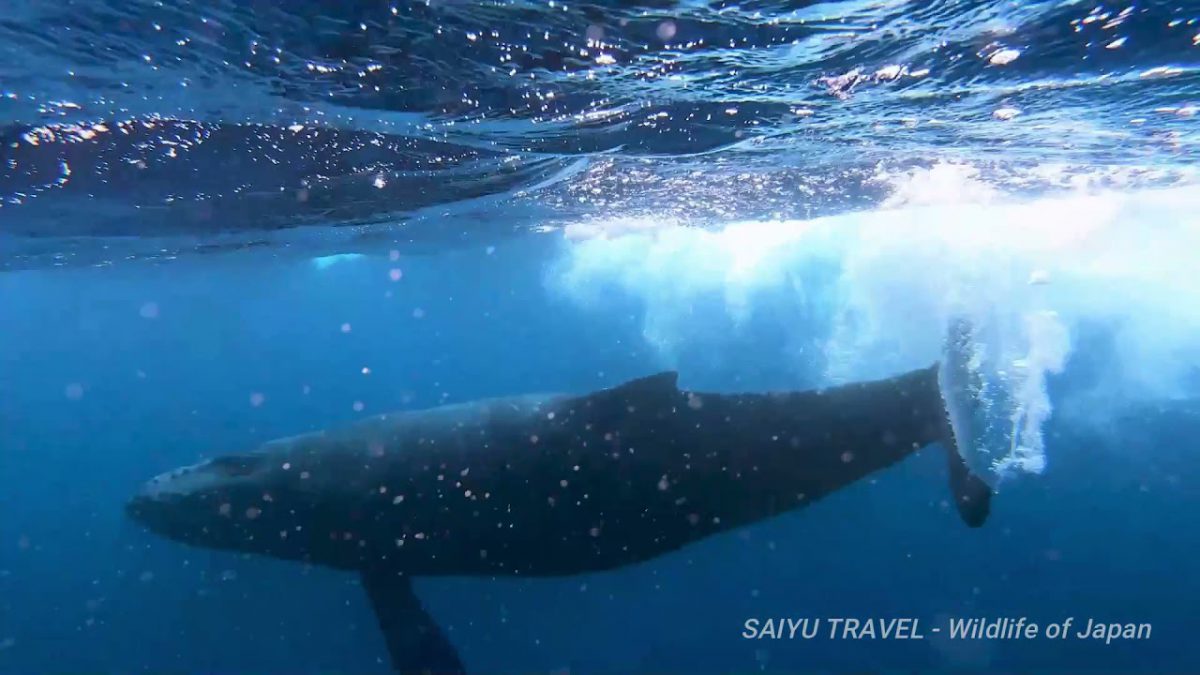
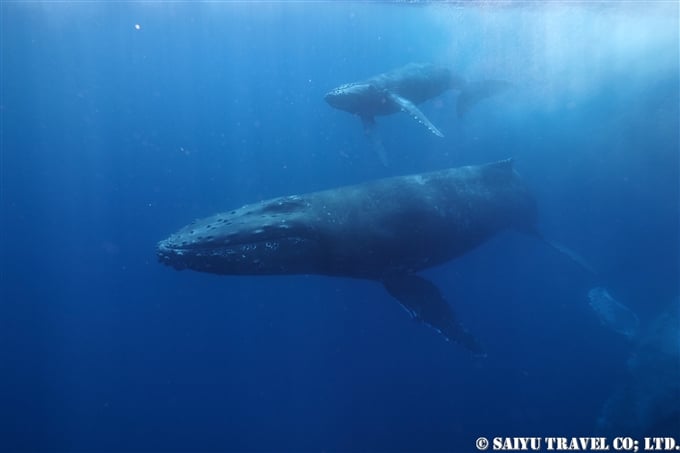
This is the highlight reel of the late March Amami Oshima Swim with Whales Tour. The main attraction of Amami Oshima is that you can do both whale watching and swimming here.
Amami Oshima is the main island of the Amami Island chain located between Kagoshima Prefecture in Kyushu and the Okinawa Islands. Every year, humpback whales migrate here from January to March. Some of the whales will stay nearby, while others migrate further south to Okinawa’s main island and the Kerama Islands.
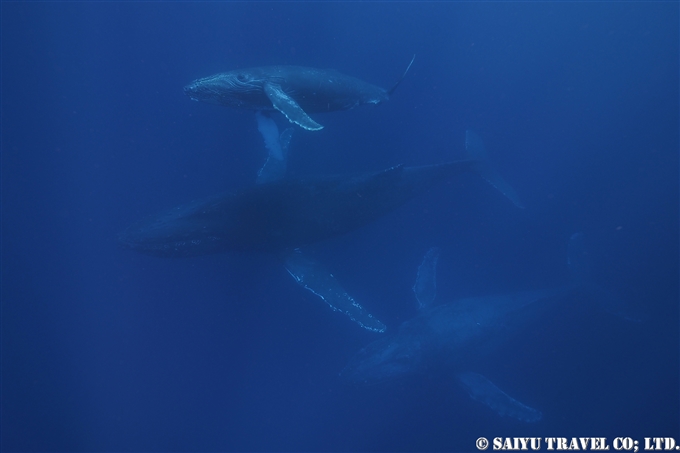
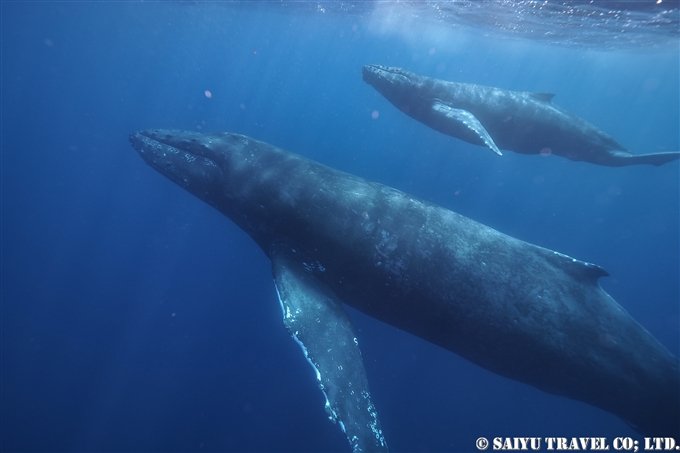
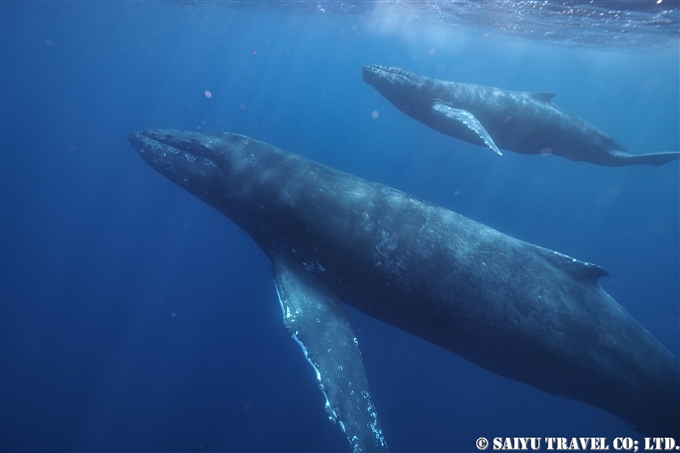
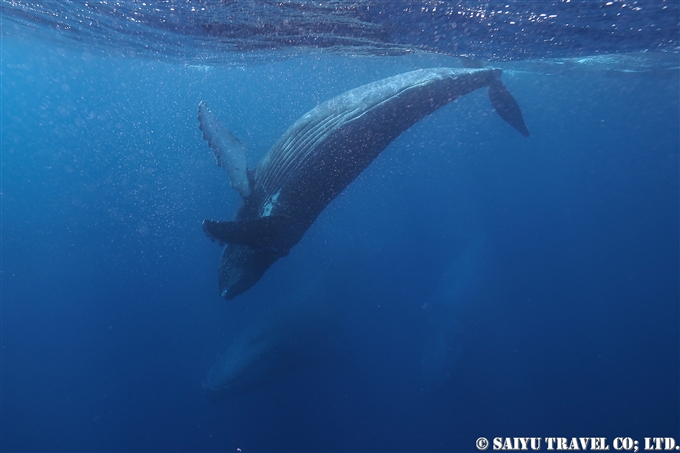
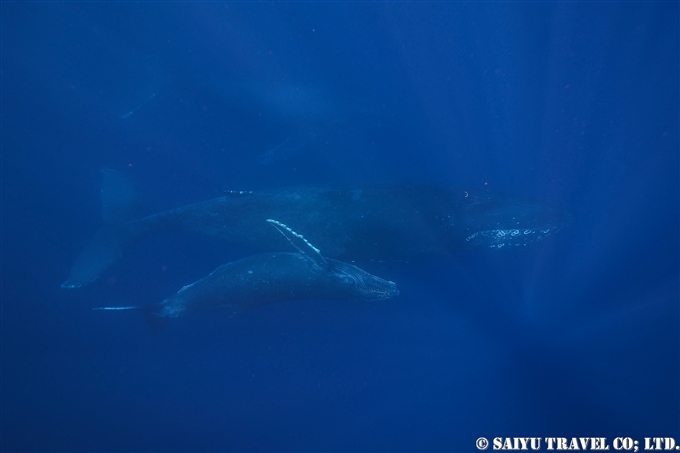
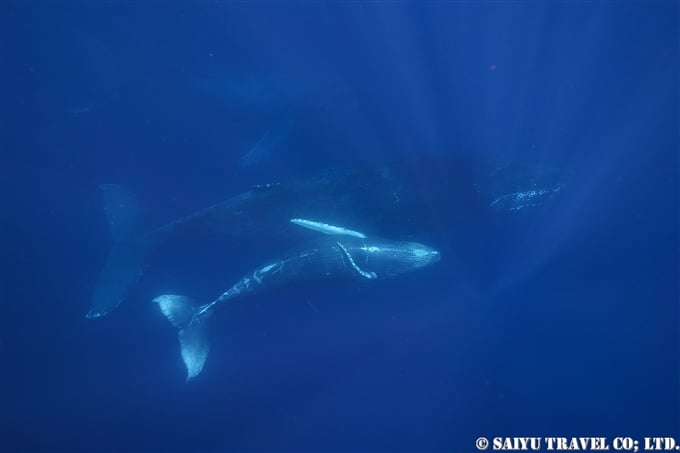
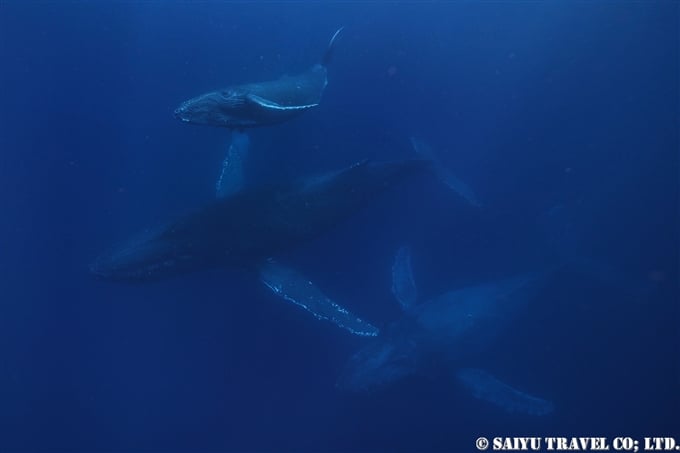
During the whale encounter, we were able to swim with three whales: a one-year old baby whale, it mother, and an escort whale.
奄美大島のザトウクジラ Humpback Whale in Amami Oshima
Video: Mariko SAWADA
Observation: Mar 2021, Amami Oshima
Special Thanks: Dive Species AMAMI
This is a report of the Amami Oshima Whale Watching Tour from early March.
Every year from January to March, the Humpback Whales, which spend their summers of Kamchatka-Aleutian Islands, will spend their winter months in Amami Oshima for breeding. Most of them head south to the Kerama Islands of Okinawa, but whales some stay near the Amami Islands. There, you might be able to encounter mother whales as they are nursing young whales or the male escort whales that will chase after the females in a ‘heat run.’
On this tour, we had some inclement weather so we could only go out to see for 3 of the 5 days. Despite the short time observing, we could manage to see a ‘heat run’ from the boat, as well as see the mother and calf plus an escorting male whale in the water. The calf was about a year old and very active.
In the morning hours, we couldn’t encounter any whales, but during the afternoon, we were told “There is a wonderful mother and calf out here now” and we rushed to the area. As soon as we could, we were in the water and the pair appeared right in front of us. It is really amazing to see them in person.
The frolicking yearling calf. It was active, doing tail slaps and pectoral fin slaps at the surface of the water.
This mother whale was very tolerant and with the escort whale watches the calf very closely. Even when the people were close to her calf. This mother must have experience raising her calves and has perhaps gotten used to humans, too.
The calf also swam in circles around its mother, showing us its belly. One day, this calf will grow up and leave the Amami Oshima area, moving north as it sets out independently by that time.
This one shot of the three whales together was a stunning highlight for the day!
Perhaps you are wondering what we did when we couldn’t get out to sea? We went for nature walks in the virgin forests of Kinsakubara, did some birdwatching, explored mangroves by canoe, and searched for the endemic Amami rabbit (Pentalagus furnessi). We could enjoy a full tour of all the beautiful natural areas the Amami Islands has to offer!
Photo & Text: Mariko SAWADA
Observation: Mar 2021, Amami Oshima, Kyushu
Special Thanks: Dive Species AMAMI










、コクマルガラス(左2羽)-1.jpg)

とソデグロヅル(手前)Izumi-Crane-Japan-Ariake-Sea -1.jpg)
とミヤマガラス.jpg)



奄美大島ダイビング-Amami-Oshima-Scuba-Diving-18.jpg)