The Mystery Circles of the Sea: Amami Oshima’s White-Spotted Pufferfish

Discover the Magic of Amami Oshima’s Sea Amami Oshima,  a UNESCO World Natural Heritage site, is a diver’s paradise. In the southern part of the island lies Setouchi Town, where the Oshima Strait—nestled between the main island and Kakeroma Island—offers breathtaking views of its rias coastline and crystal-clear waters.
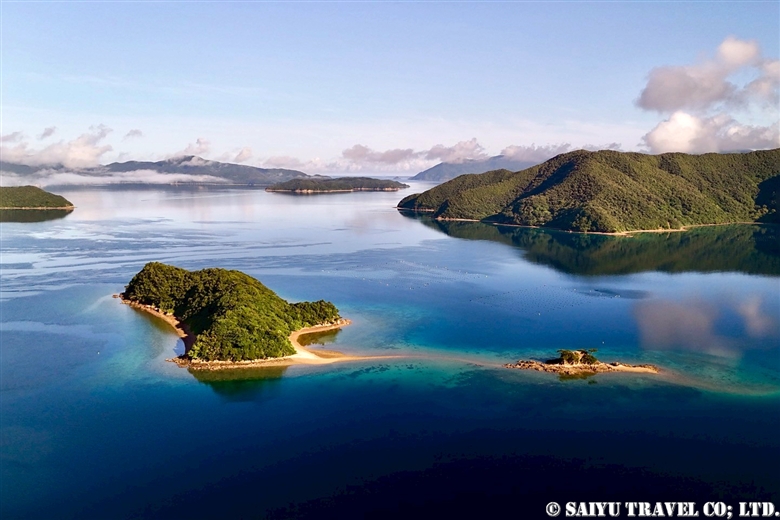
Views of the Oshima Strait (Aerial drone shot by AquaDive Kohollo)

↓↓ Watch: How the White-Spotted Pufferfish creates its Mystery Circle

↓↓ A chance to swim with Indo-Pacific bottlenose dolphins in the Oshima Strait!

The Mystery of the Deep

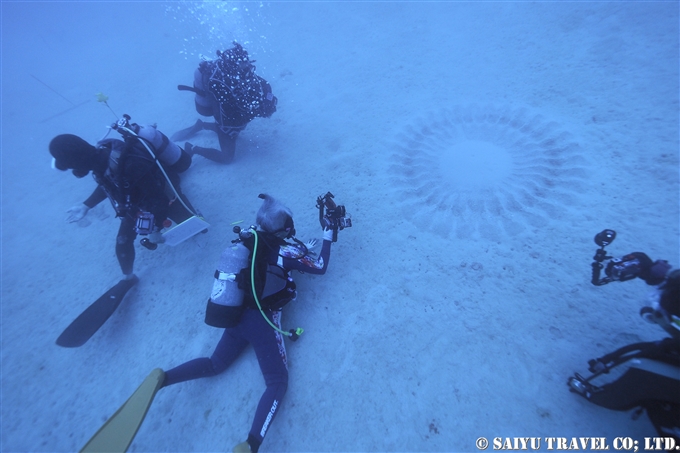
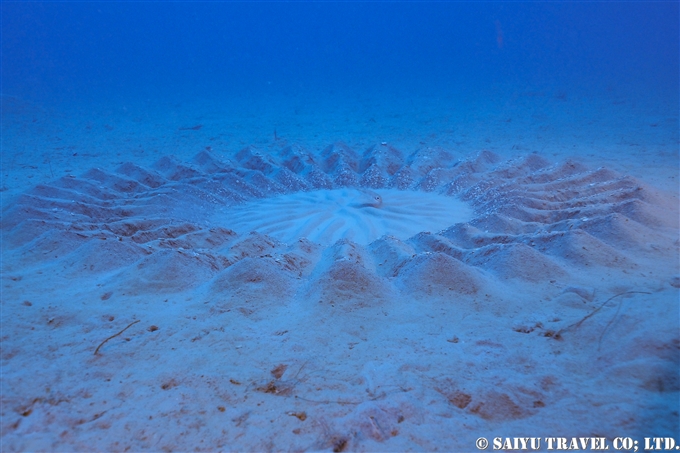
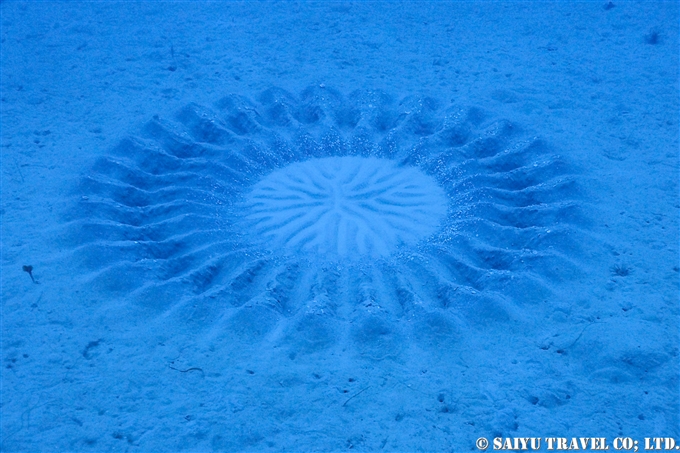
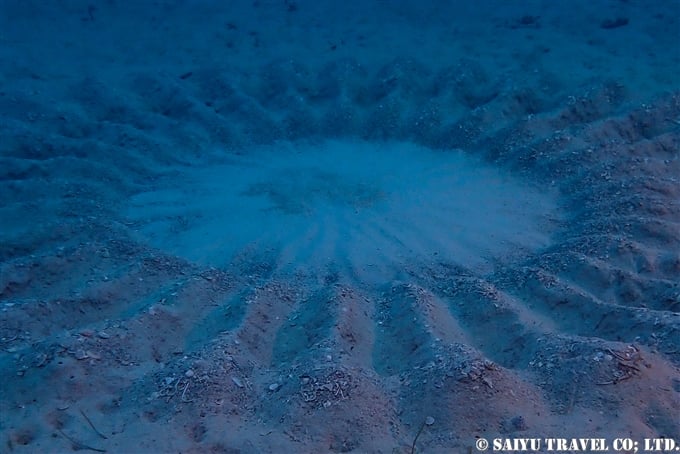
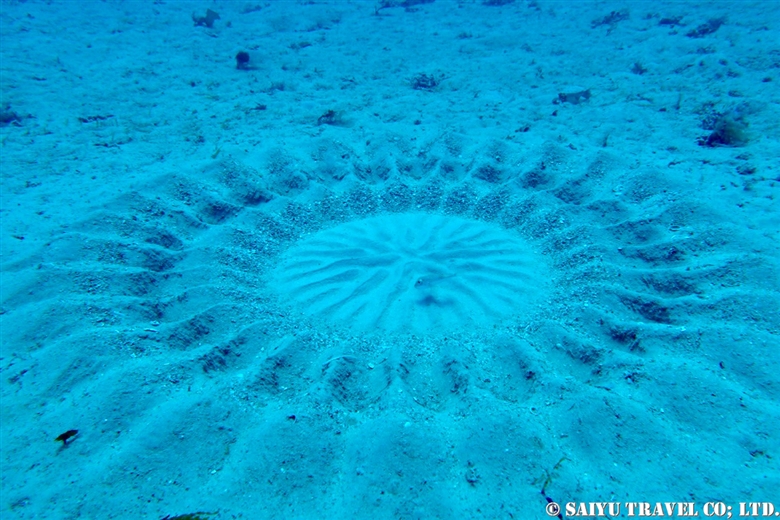
Since around 1995, mysterious geometric patterns, about 2 meters in diameter, were discovered on the sandy seabed of Amami. These became known as “Mystery Circles,” and for 16 years, no one knew who created them.
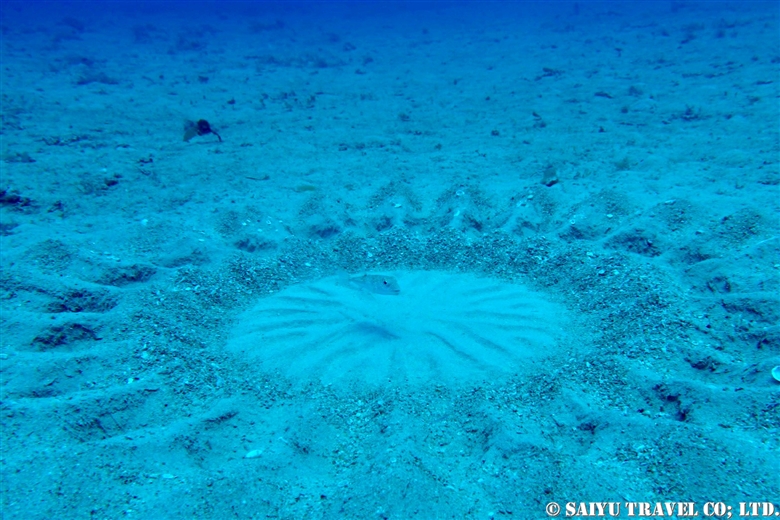
The ‘Mystery Circles’ of the seabed that remained a puzzle for many years

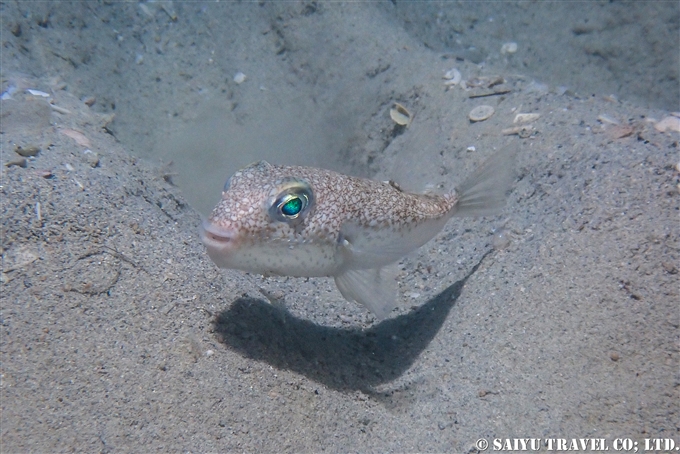
It wasn’t until 2011 that underwater photographer Yoji Okata finally caught the artist on camera: a tiny pufferfish! In 2014, it was officially named the White-Spotted Pufferfish (Japanese name: Amami-no-Hoshizora-Fugu).

Later, it was discovered that these pufferfish live not only in the southern part of Amami Oshima, but also along the northeastern coast of Kakeroma Island and in the sandy depths of Kasari Bay in the north, at around 30 meters deep.
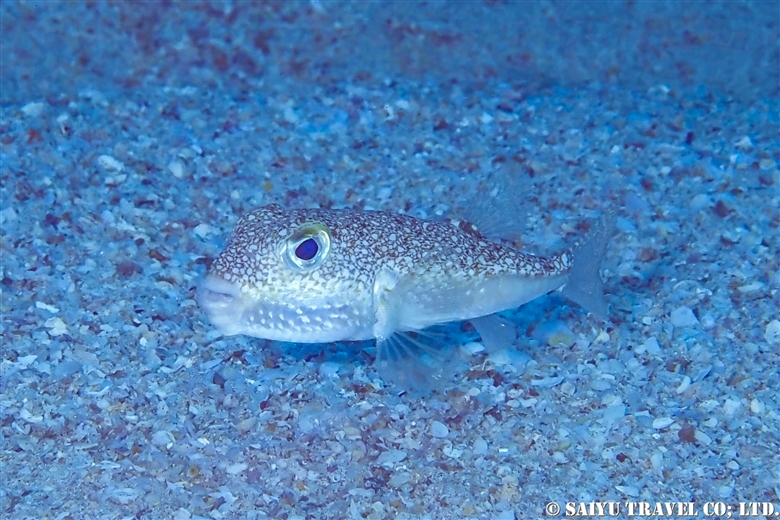
Japanese name : Amami-no-Hoshizora-Fugu アマミノホシゾラフグ

The name Hoshizora means “Starry Sky.” It comes from the beautiful white spots on the pufferfish’s back, which look just like the glittering stars in the clear night sky over Amami Oshima.

These Mystery Circles are actually spawning nests built by the males. Despite being only 10-15cm long, the male spends 7 to 9 days working without rest to dig grooves and create ridges using its fins. The more perfect the circle, the more likely he is to attract a mate!

When a female arrives, a unique ritual begins: the male gently bites the female’s cheek. This stimulates her to lay eggs and keeps her steady in the center of the nest. Once the eggs are laid, the devoted father stays for about a week to protect them and fan them with fresh seawater until they hatch.

Observing the Pufferfish (Photography by AquaDive Kohollo)

On our diving tours, you can observe the entire process, starting from the circle-making itself. If you’re lucky, you might even witness a female arriving or a male devotedly caring for the eggs. However, please note that these mystery circles are usually found at depths of around 30 meters, making observations difficult if they are located any deeper.

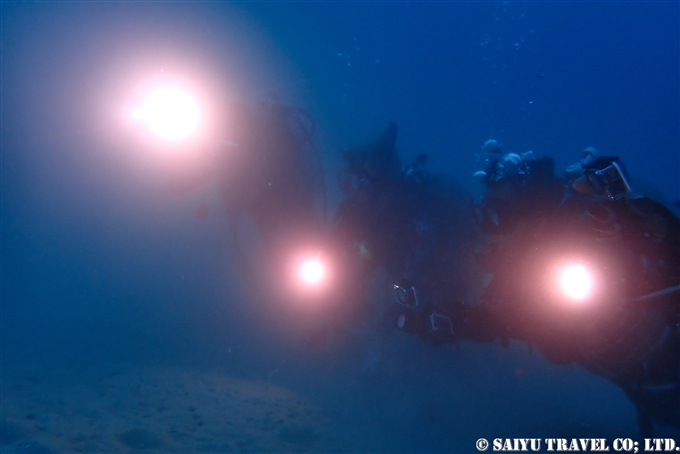
When observing, we take great care not to disturb the pufferfish or kick up any sand. While using a strobe is currently permitted, there may be restrictions on the use of continuous lights. Please be sure to follow the specific rules set by local diving association.

More to Explore

The Oshima Strait is a treasure trove of marine life. Beyond the pufferfish, you might even have the chance to swim with Indo-Pacific bottlenose dolphins! You can also find rare creatures like the Sutsubo-sando-yadokari (a hermit crab discovered in 2017) and the colorful Boxer Crab.

This hermit crab, called Sutsubo-sando-yadokari, was only just described as a new species in 2017. What makes it truly unique is that it carries and walks around in a ‘living coral’ instead of a shell.
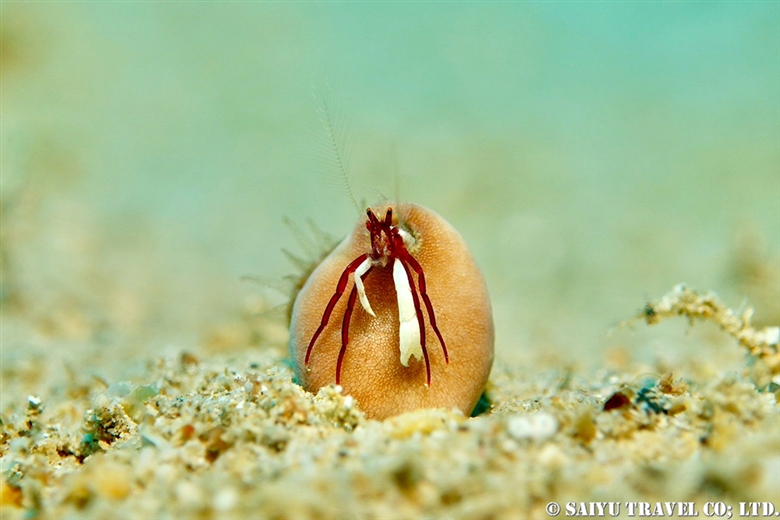
Sutsubo-sando-yadokari (a hermit crab discovered in 2017) (Photography by AquaDive Kohollo)

It is a tiny hermit crab, characterized by its vibrant red legs and white claws peeking out from the coral.
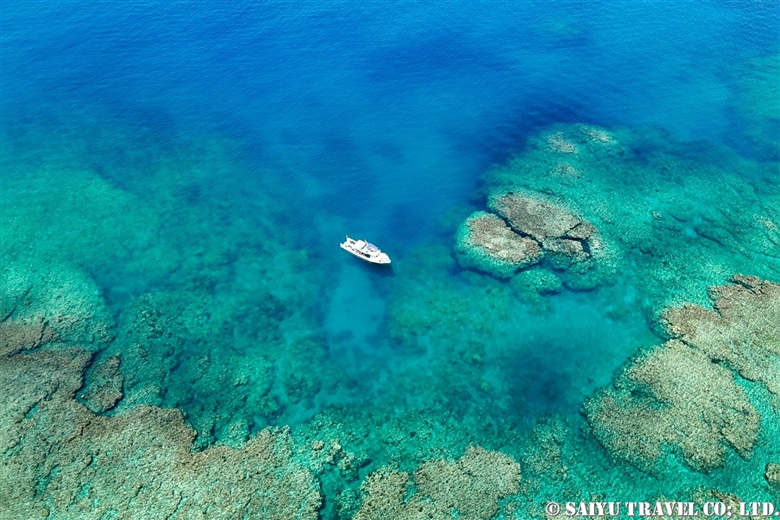
The beautiful waters of the Oshima Strait in southern Amami Oshima (Aerial drone shot by AquaDive Kohollo)
A lucky find: The adorable Boxer Crab
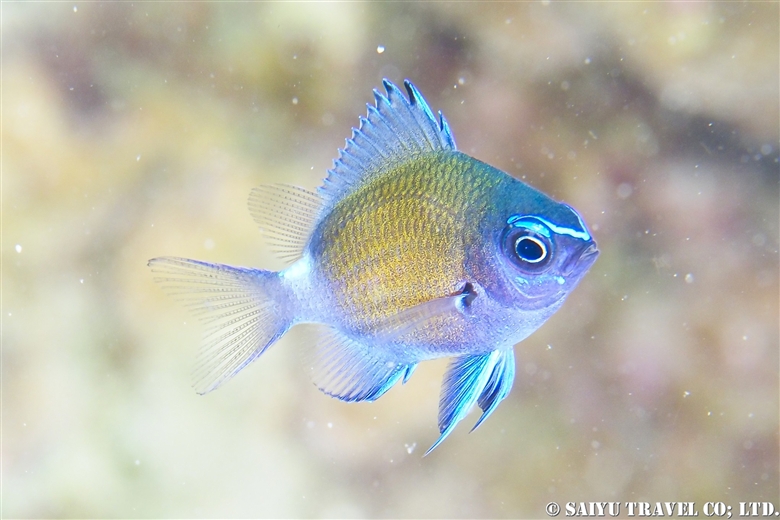
Young Amami Damselfish
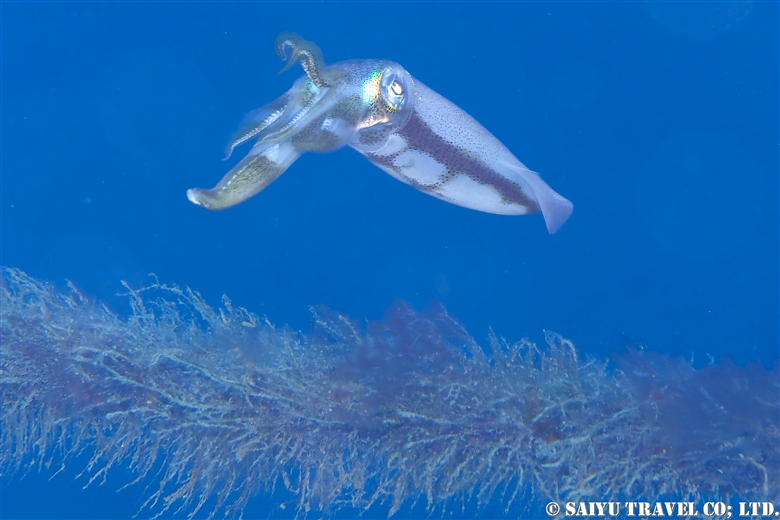
A juvenile Bigfin Reef Squid approaching the boat
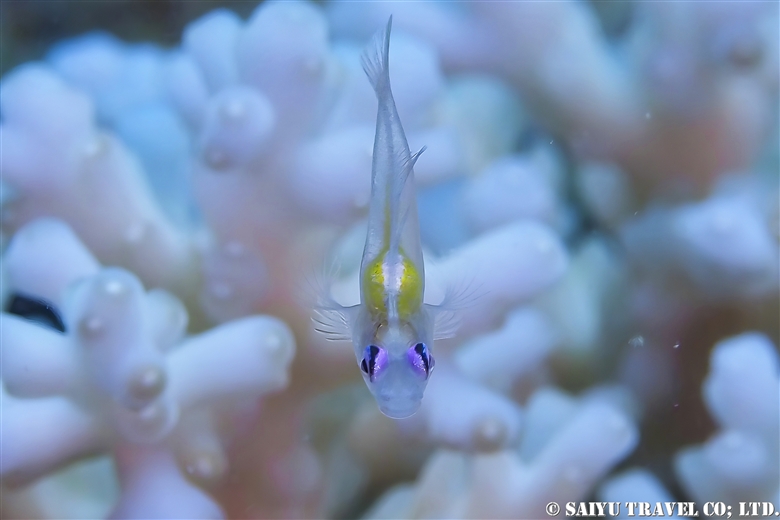
Red-eye Goby
Surrounded by a fun-loving diving team (Photography by AquaDive Kohollo)

If you’re looking for a diving experience filled with wonder and natural art, come and see the Mystery Circles of Amami Oshima!


Image : Mariko SAWADA,  AquaDive Kohollo

Text : Mariko SAWADA

Location : Amami Oshima


■Related Articles: Amami Oshima

Scuba Diving Amami Oshima

The White-Spotted Pufferfish Circle Formation(Amami Oshima)

(Video) Humpback Whale Watching & Swim in Amami Oshima

Mother and Calf Humpback Whales (Amami Oshima)

■Please contact us for inquiries regarding diving and whale swim tours (Humpback & Sperm whales) in Amami Oshima

■Wildlife videos are also available on Youtube

■Follow us on Instagram

Tags: , , , , , , , , , ,

Scuba Diving Amami Oshima

This is a report of a diving trip in Amami Oshima in May. The main focus of this trip was for observing the white-spotted pufferfish, Torquigener albomaculosus. Ten of the 15 dives were to witness the process of circle-making pufferfish, and the remaining 5 dives were planned for seeing the other spectacular creatures of Amami.

This is the season for broadclub cuttlefish spawning. Originally, I was planning to observe the broadclub cuttlefish but this year their numbers was so small that we could not see group spawning that typically happens. Behind the Porites cylindrica are some broadclub cuttlefish eggs. You can see the baby inside, it’s still so very small.

コブシメの体色変化 color change of Broadclub cuttlefish

The amazing ability of the broadclub cuttlefish to change colors is interesting. When I get too close to it, it expresses its bad mood and turned black, but after I moved off a little, it started to mimic the surrounding, lol!

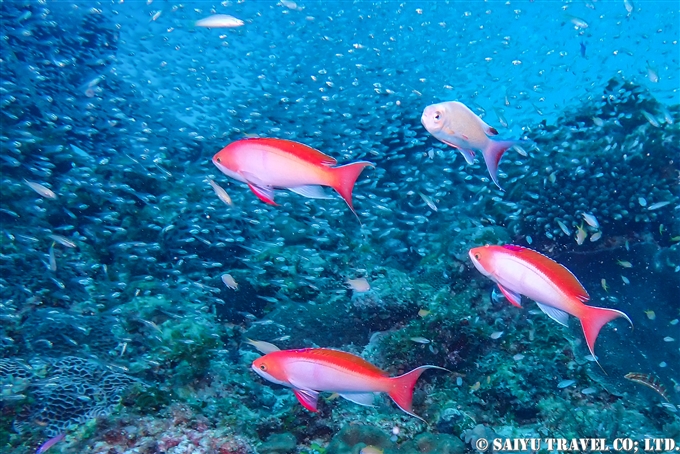
Swimming male Red Fairy Anthias Pseudanthias cooperi, which were at the bottom of a sandy area. The school of Luminous cardinalfish, Rhabdamia gracilis so beautifully swimming and framing the background.

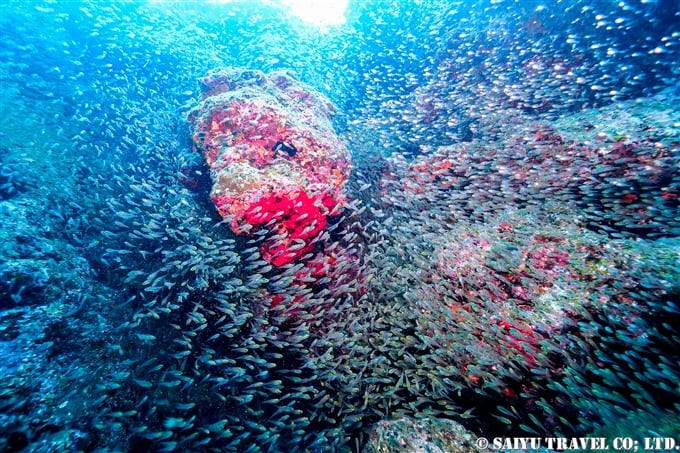
Right at the edge of the reef, a big school of Golden sweepers, Parapriacanthus ransonneti.

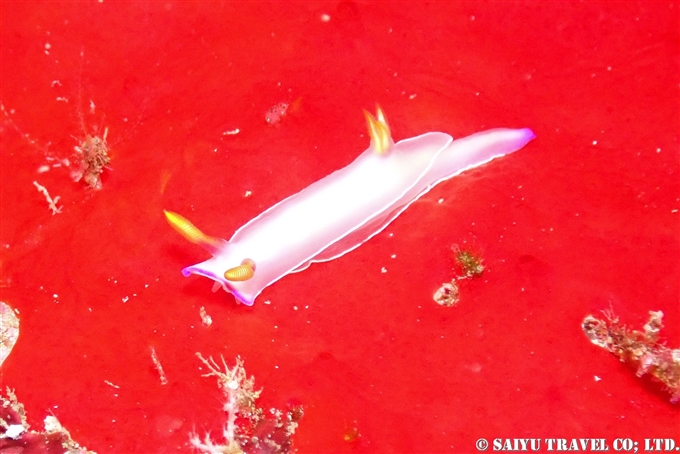
ゾウゲイロウミウシ Hypselodoris bullockii 奄美大島ダイビング Amami Oshima Scuba Diving (10)
Photography by Chizuko MURATA

I photographed the nudibranch Hypselodoris bullockii on a red sponge. It looks like a pattern on a Japanese traditional cloth.

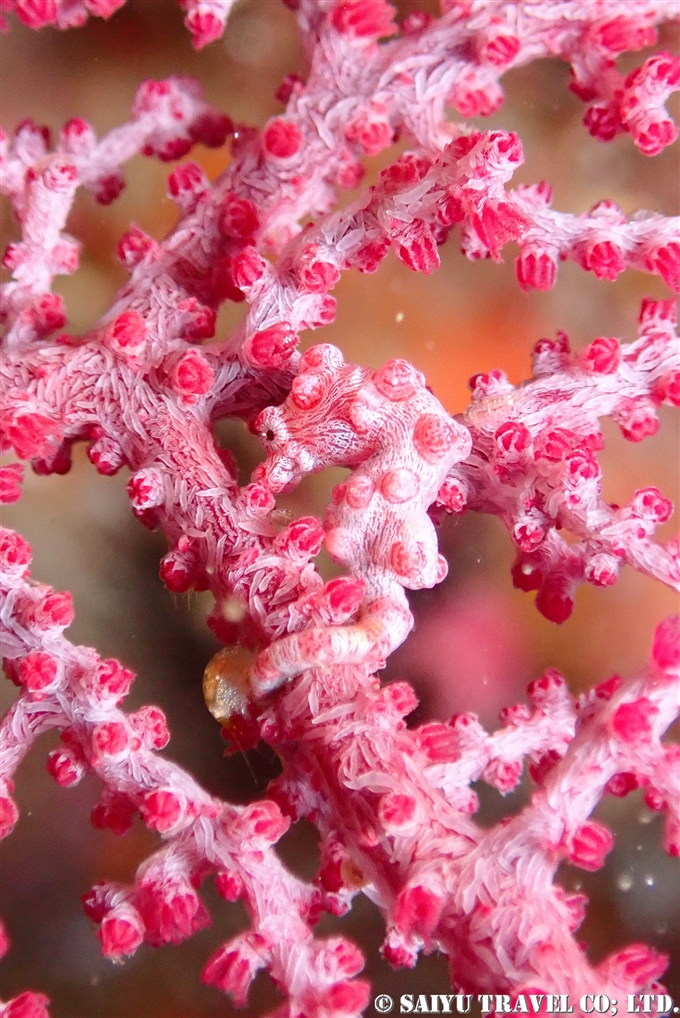
Japanese pygmy seahorse 奄美大島ダイビング Amami Oshima Scuba Diving (10)
Photography by Chizuko MURATA

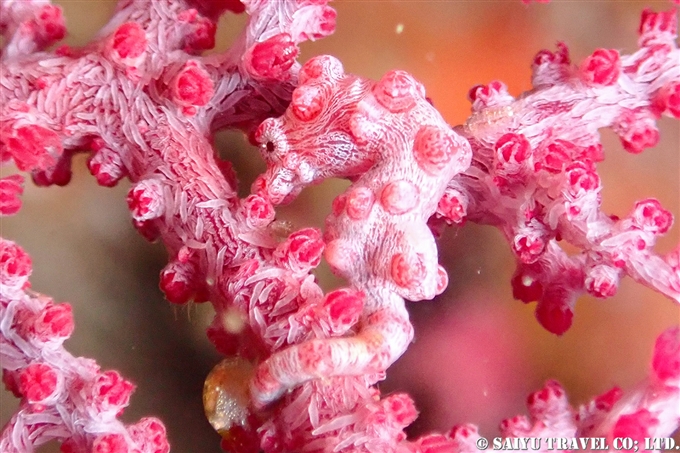
One of the highlights of this diving spot is that we can see pygmy seahorse, Hippocampus bargibanti at a shallow depth of 15m. This pygmy seahorse, which attaches to the red or yellow soft coral. It will mimic with amazing accuracy and becomes the same color as the coral, even mimicking the polyps. When it was first pointed out to me in Ogasawara, I could not even see it, but now, after several opportunities to see it, over and over again, I have gotten just a little better at spotting it.

And this is the “Great Buddha” Coral. It is a large common coral group called Pavona clavus.

The Amethyst anthias, Pseudanthias pascalus schooling above the coral.

The breeding colors of an Amethyst anthias male with a yellow tail

ハナゴイ乱舞 Purple queen wild dance(Videography by Chizuko MURATA)

It was so spectacular to see the little Amethyst anthias, which looked like falling rain at times.

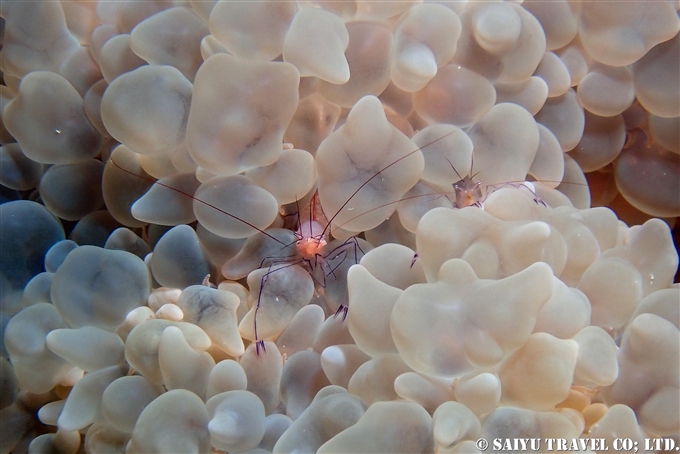
The Bubble coral shrimp Vir philippinensis. It was holding an egg.

And the highlight of this tour, is the observation of the white-spotted pufferfish circles. The ocean bottom is a fine sand, and you have to be very careful about not messing it up. After staying a while, it will become cloudy.

A rainy day with poor water clarity, looks like this. Because of the depth and the risk of having bad visibility, those who want to observe the pufferfish closely, should make sure they have multiple diving chances.

Putting the finishing touches on the pufferfish’s circle.

This is the completed circle. For these small fish to do all the work using their bodies, who work on the circle and don’t seem to look at it from above, it is quite an impressive feat.

Now, it is just about attracting the female. This is the diligent male white-spotted pufferfish.

The next day, in the center of the circle where the eggs were laid (the gray mass in the middle). After this, the male will take care of the eggs and the circle will no longer be maintained.

I stayed at Amami Oshima for 6 consecutive nights, and I was really looking forward to the daily meals. Every day is a glorious feast! Octopus, cuttlefish, yellowfin tuna, other seabream species, green turban, … the list goes on!

It was rainy season in Amami Oshima, but during this diving tour we made sure to plan a way to enjoy the ocean and the bounty of food it provides. Thank you to everyone who joined the tour, to our underwater guide-Dive Species Amami, Mr and Mrs. Suwa!

Images & Text: Mariko SAWADA
Some photographs and video: Chizuko MURATA
Observation: May 2022, Amami-Oshima
Special Thanks: Dive Species Amami, Mr. Homare SUWA

Tags: , , , , , , , , , , , , , , , , ,

The White-Spotted Pufferfish Circle Formation(Amami Oshima)

These “Mysterious Underwater Circles” of Amami Oshima became a hot topic when a TV program introducing them was broadcasted. Originally found by an underwater photographer in 1995, he didn’t know who made them and for what purpose they were there. It was in 2011, that we finally discovered that it was made by small pufferfish.

The Amami Oshima’s “Mysterious Underwater Circle” is often made nearly 30m deep, so it is hard to observe for long at that depth; and the seasons and tides limit the divers’ abilities to observe these circles, so it took 16 years before we were able to meet its creator, the pufferfish.

This is the male pufferfish, Torquigener albomaculosus, the creator of the circle. In 2014, this pufferfish was registered as a new species. The Japanese name “Amami Hoshizorafugu” is named so because of the dotted pattern on its back, like the many stars in the beautiful night sky of Amami Oshima. (In Japanese “Hoshizora”= starlit night sky, “fugu” = pufferfish)

We observed this white-spotted pufferfish over five days, as it was constructing the circle. In this photo, the pufferfish is decorating the outer edge of the circle with shells. It seems that the fish shapes the shell by chewing on a larger shell in its mouth.

The first step in creating the circle, is for the pufferfish to choose a spot that it likes and begin by removing and seaweed from the area. Then it will make a groove which will be the basis of the circle. For the making of the outer circle, the groove is formed by the small fish using its pectoral fins to roll up the sand moving from side to side. Slowly, the sand is piled up on both sides to form a deeper groove.

The center of the circle, where the eggs will be laid, is made into a gentle shallow area using its stomach.

White-spotted pufferfish which has finally finished making its circle. But even then, it’s very busy with maintenance to keep the shape.

Now it is just a waiting game, until a female pufferfish comes by and likes his circle!

At this time in May 2022, during high tide there were seven circles in the diving area. This morning, one male had success as there were some eggs in the middle of the circle! The gray color mass in the middle of the photo are the eggs.

As soon as the female lays the eggs, she disappears and the male will take care of the eggs in his circle. He will consistently move the eggs and sand with its fins and continue to send them fresh seawater.

A male white-spotted pufferfish who is busy taking care of his eggs. The maintenance of the circle stops and therefore the shape is starting to collapse a little.

So, in this 30m deep area where we were diving, we could see 6 of the 7 circles had eggs. But the one that had no eggs yet, which we nicknamed “Fuguta,” this was the circle that I thought was “the most beautiful and splendid circle” but sadly, it wasn’t chosen by a female pufferfish. I am sure there is a difference between the pufferfish and our senses, but even so, I was disappointed that it was not selected…it was like a Japanese saying that “it was the crowd favorite, but it failed to qualify for the finals.”

Our little “Fuguta,” who was dedicated to the maintenance of his circle. He was laboring over it, however, he wasn’t as energetic as yesterday.

“Fuguta” would not give up! The breeding season will continue for another two months. I left the seabed praying for him, that he’ll be able to attract another female during the next high tide.

Of the 15 dives over a 5 day period, 10 dives were spent observing the white-spotted pufferfish. We observed all the various stages from circle construction, the maintenance, and then of taking care of the eggs. It looks a very smart fish.

Photos & text: Mariko SAWADA
Observation: May 2022, Amami Oshima
Special Thanks: Dive Species Amami, Mr. Homare SUWA

Tags: , , , , , , , , , , , , , , ,