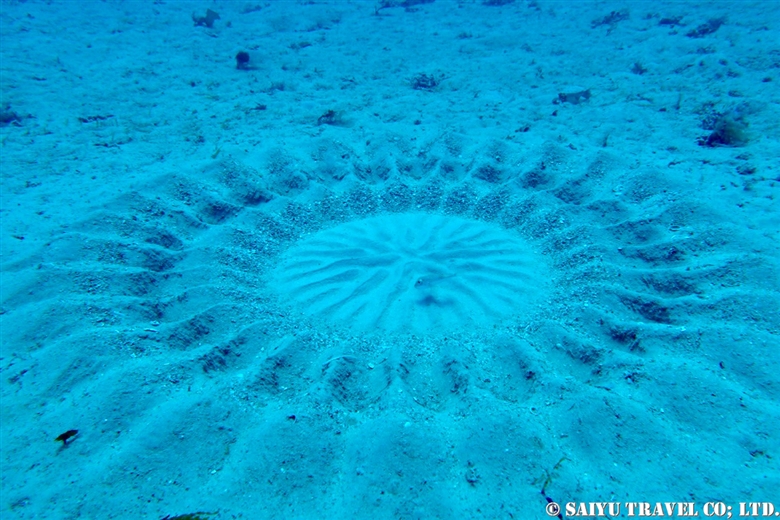
The Mystery Circles of the Sea: Amami Oshima’s White-Spotted Pufferfish

Discover the Magic of Amami Oshima’s Sea Amami Oshima,  a UNESCO World Natural Heritage site, is a diver’s paradise. In the southern part of the island lies Setouchi Town, where the Oshima Strait—nestled between the main island and Kakeroma Island—offers breathtaking views of its rias coastline and crystal-clear waters.
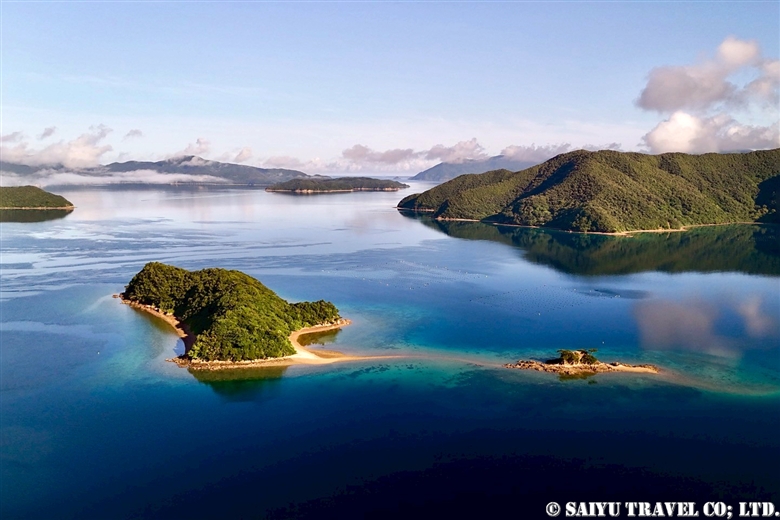
Views of the Oshima Strait (Aerial drone shot by AquaDive Kohollo)

↓↓ Watch: How the White-Spotted Pufferfish creates its Mystery Circle

↓↓ A chance to swim with Indo-Pacific bottlenose dolphins in the Oshima Strait!

The Mystery of the Deep

Since around 1995, mysterious geometric patterns, about 2 meters in diameter, were discovered on the sandy seabed of Amami. These became known as “Mystery Circles,” and for 16 years, no one knew who created them.
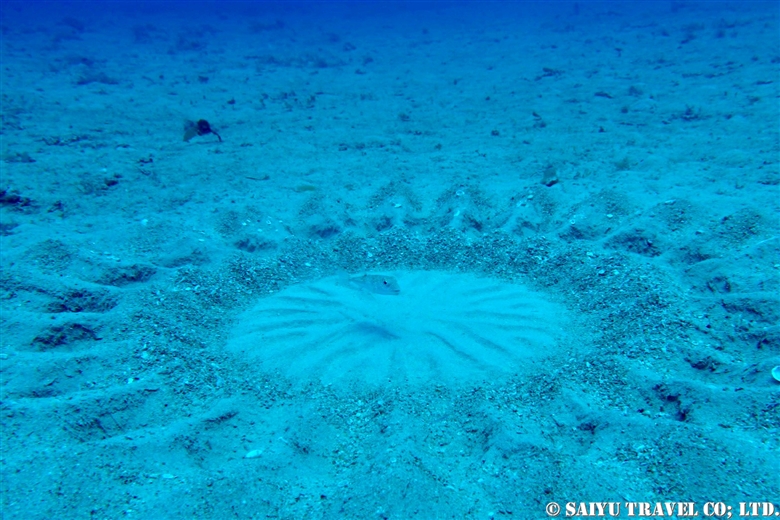
The ‘Mystery Circles’ of the seabed that remained a puzzle for many years

It wasn’t until 2011 that underwater photographer Yoji Okata finally caught the artist on camera: a tiny pufferfish! In 2014, it was officially named the White-Spotted Pufferfish (Japanese name: Amami-no-Hoshizora-Fugu).

Later, it was discovered that these pufferfish live not only in the southern part of Amami Oshima, but also along the northeastern coast of Kakeroma Island and in the sandy depths of Kasari Bay in the north, at around 30 meters deep.
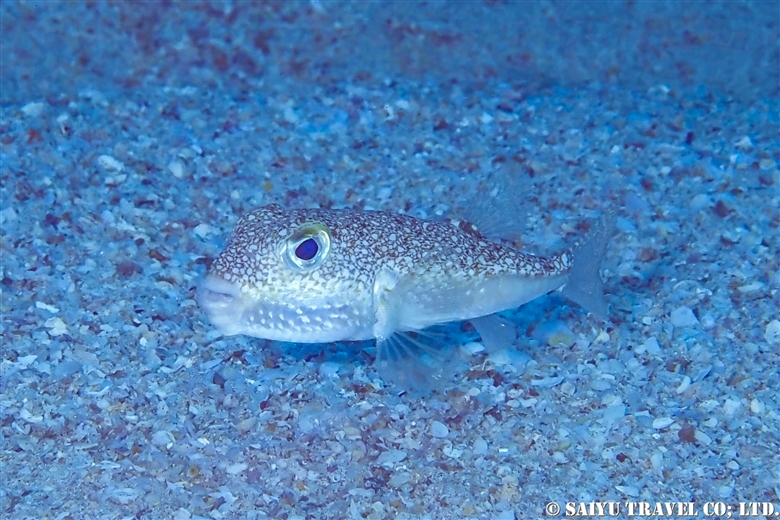
Japanese name : Amami-no-Hoshizora-Fugu アマミノホシゾラフグ

The name Hoshizora means “Starry Sky.” It comes from the beautiful white spots on the pufferfish’s back, which look just like the glittering stars in the clear night sky over Amami Oshima.

These Mystery Circles are actually spawning nests built by the males. Despite being only 10-15cm long, the male spends 7 to 9 days working without rest to dig grooves and create ridges using its fins. The more perfect the circle, the more likely he is to attract a mate!

When a female arrives, a unique ritual begins: the male gently bites the female’s cheek. This stimulates her to lay eggs and keeps her steady in the center of the nest. Once the eggs are laid, the devoted father stays for about a week to protect them and fan them with fresh seawater until they hatch.

Observing the Pufferfish (Photography by AquaDive Kohollo)

On our diving tours, you can observe the entire process, starting from the circle-making itself. If you’re lucky, you might even witness a female arriving or a male devotedly caring for the eggs. However, please note that these mystery circles are usually found at depths of around 30 meters, making observations difficult if they are located any deeper.

When observing, we take great care not to disturb the pufferfish or kick up any sand. While using a strobe is currently permitted, there may be restrictions on the use of continuous lights. Please be sure to follow the specific rules set by local diving association.

More to Explore

The Oshima Strait is a treasure trove of marine life. Beyond the pufferfish, you might even have the chance to swim with Indo-Pacific bottlenose dolphins! You can also find rare creatures like the Sutsubo-sando-yadokari (a hermit crab discovered in 2017) and the colorful Boxer Crab.

This hermit crab, called Sutsubo-sando-yadokari, was only just described as a new species in 2017. What makes it truly unique is that it carries and walks around in a ‘living coral’ instead of a shell.
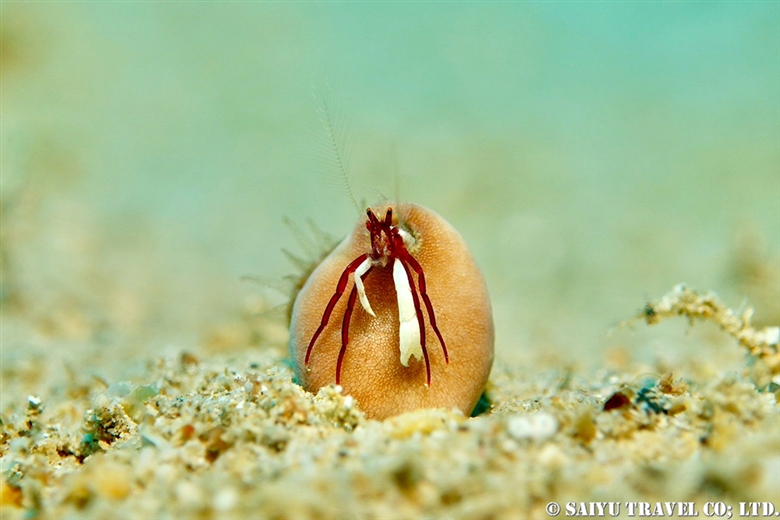
Sutsubo-sando-yadokari (a hermit crab discovered in 2017) (Photography by AquaDive Kohollo)

It is a tiny hermit crab, characterized by its vibrant red legs and white claws peeking out from the coral.
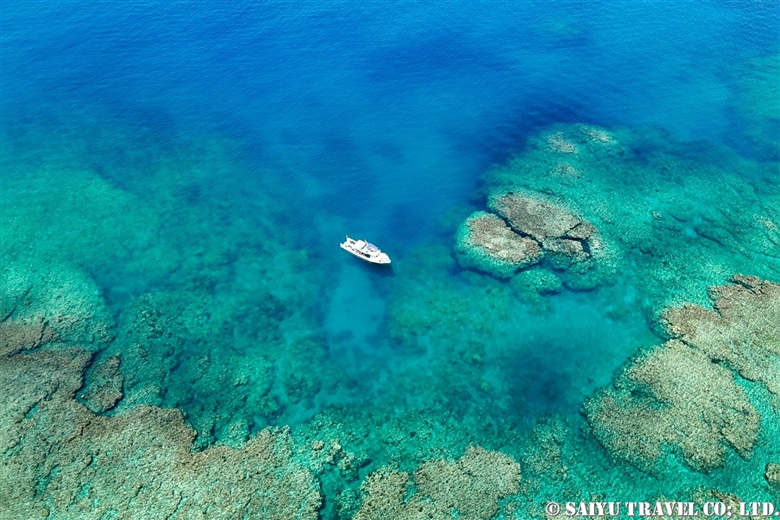
The beautiful waters of the Oshima Strait in southern Amami Oshima (Aerial drone shot by AquaDive Kohollo)
A lucky find: The adorable Boxer Crab
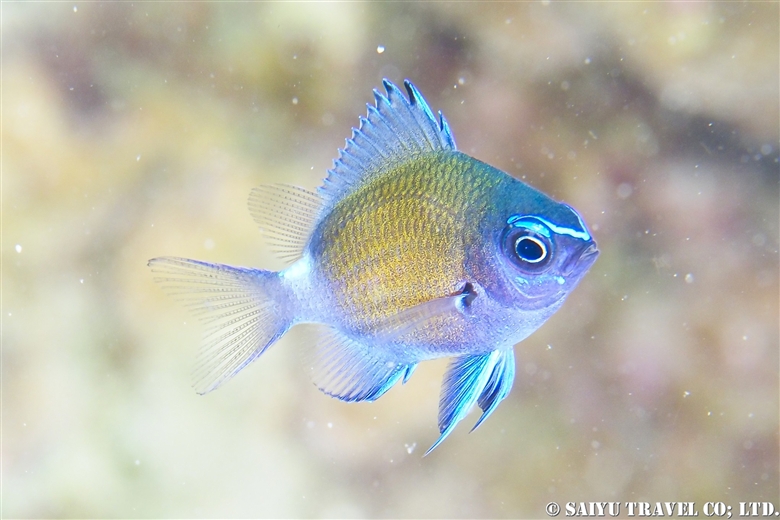
Young Amami Damselfish
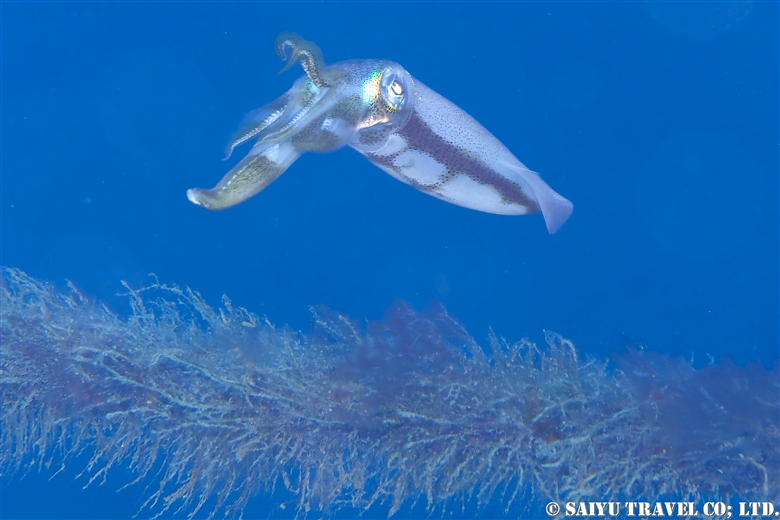
A juvenile Bigfin Reef Squid approaching the boat
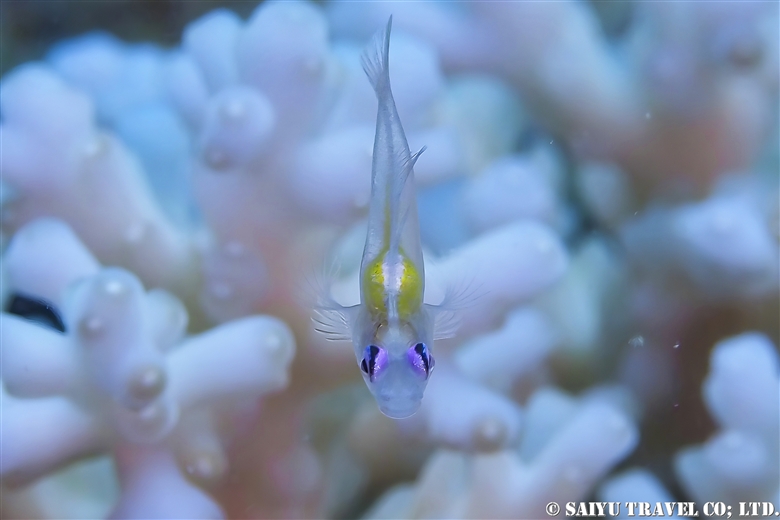
Red-eye Goby
Surrounded by a fun-loving diving team (Photography by AquaDive Kohollo)

If you’re looking for a diving experience filled with wonder and natural art, come and see the Mystery Circles of Amami Oshima!


Image : Mariko SAWADA,  AquaDive Kohollo

Text : Mariko SAWADA

Location : Amami Oshima


■Related Articles: Amami Oshima

Scuba Diving Amami Oshima

The White-Spotted Pufferfish Circle Formation(Amami Oshima)

(Video) Humpback Whale Watching & Swim in Amami Oshima

Mother and Calf Humpback Whales (Amami Oshima)

■Please contact us for inquiries regarding diving and whale swim tours (Humpback & Sperm whales) in Amami Oshima

■Wildlife videos are also available on Youtube

■Follow us on Instagram

Tags: , , , , , , , , , ,

Shakotan’s Undersea Columnar Joints and Hokkaido’s Marine Life

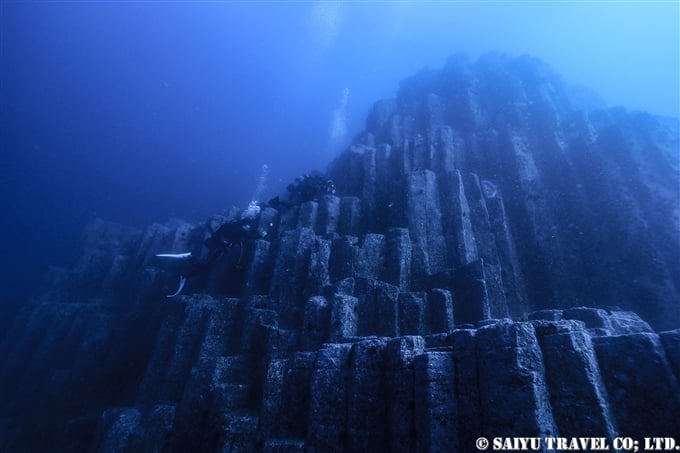
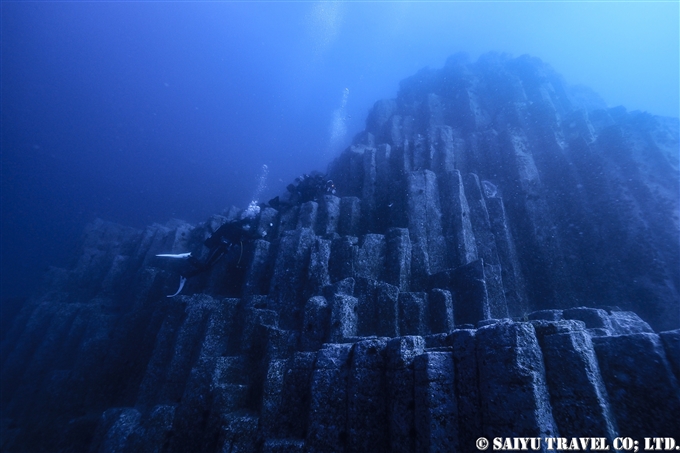
By car from Sapporo, the Shakotan Sea is 1 hour and 30 minutes by car. The scenic spot called the “Shakotan Blue” is famous for the high transparency of the water. The columnar joint formations look like underwater ruins, which are very famous.

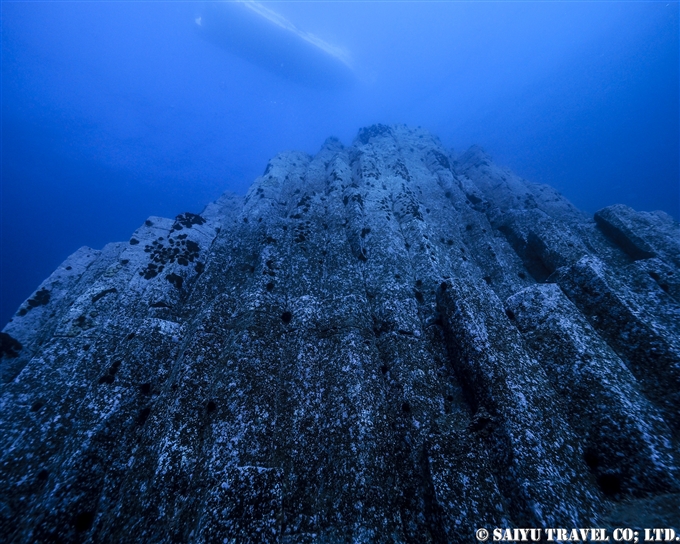
Columnar formations are polygonal columnar fissures caused by volumetric contraction as the magma solidifies and then cools. It is a manifestation of the Pacific “Ring of Fire,” also known as the “volcanic archipelago.”

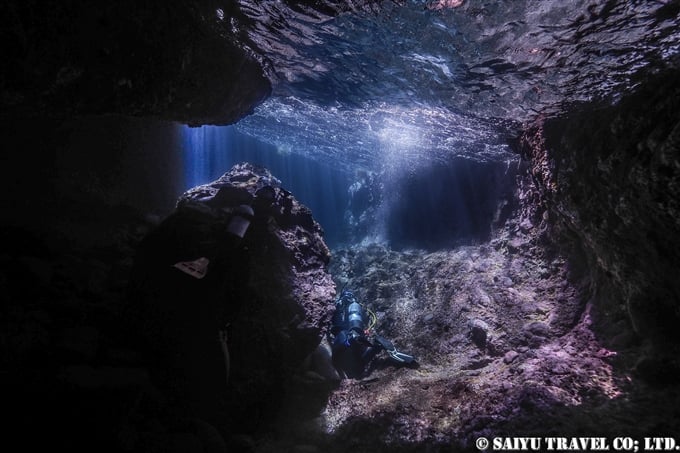
Looking up at the sea’s surface from the columnar joints.

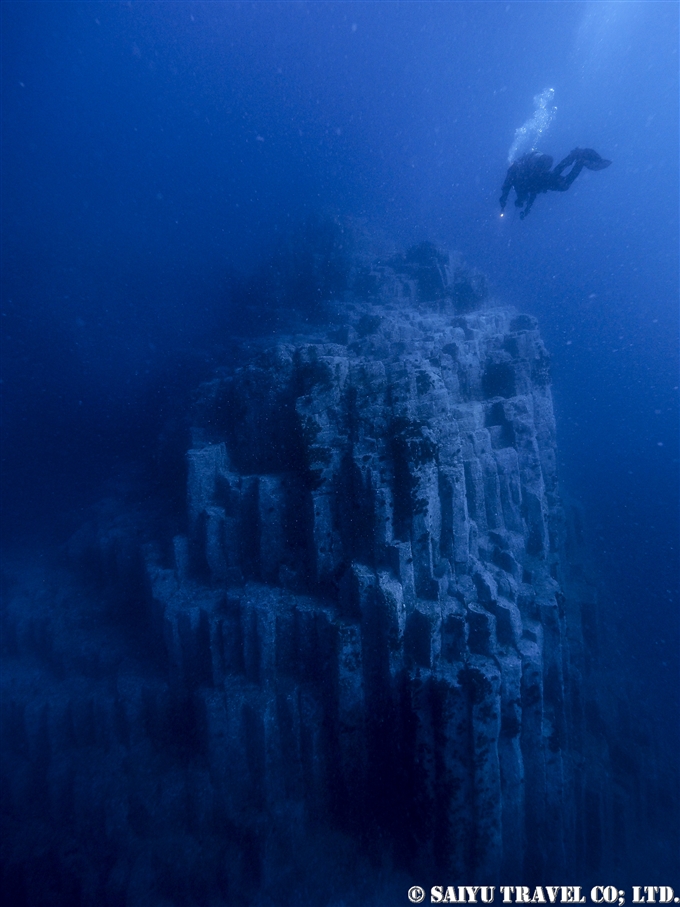
This point of the columnar joint is called the “hidden root of Biyano.” The depth here is about 25 meters, and it is too bad that it’s barely visible from the glass bottom boat.

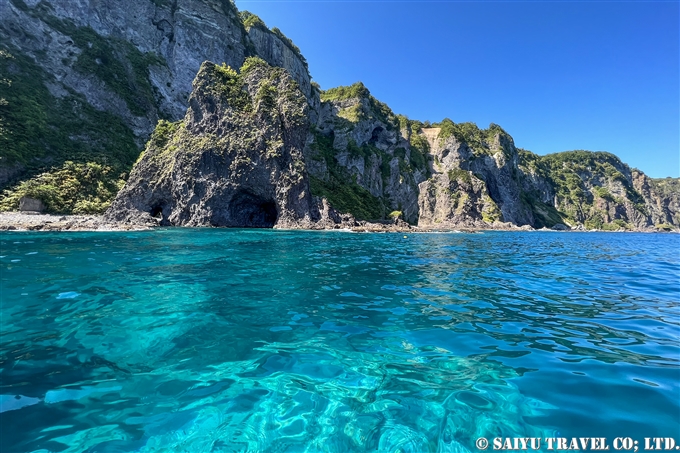
Heading towards the sites along the coastline. Diving the strait was blessed with good weather. When I visited in September, there wasn’t much marine life to see then…but I was able to see wonderful “Hokkaido’s sea creatures on the Sea of Japan side” with wonderful guides.

Ishikawa Sculpin Furcina ishikawae

Nijikajika Alcichthys elongatus

Pietsch Sculpin (Himefutasjikajika) Icelinus pietschi

Akiginpo Chirolophis saitone

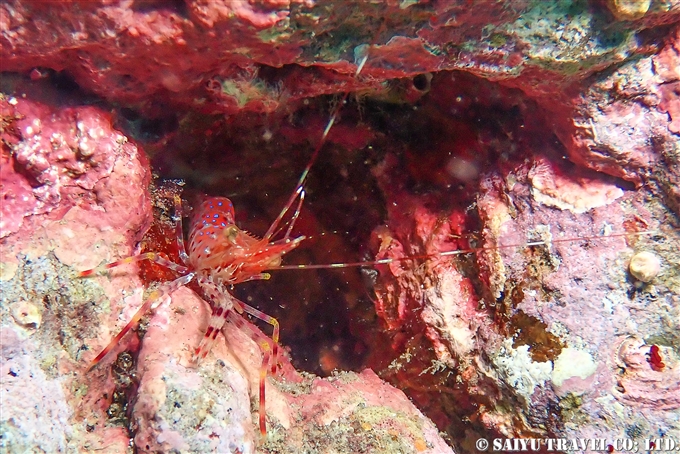
Far Eastern Shrimp Pandalus prensor Stimpson. Beautiful blue speckles. If eating it raw, it tastes like sweet pink shrimp.

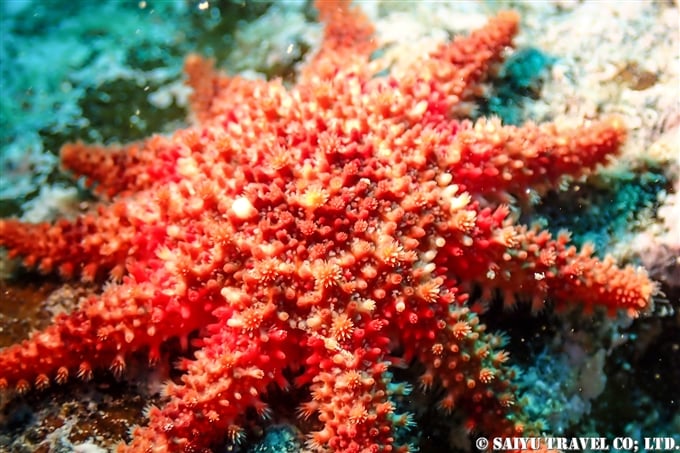
Common Sunstar Crossaster papposus. There are many legs, just like sunrays.

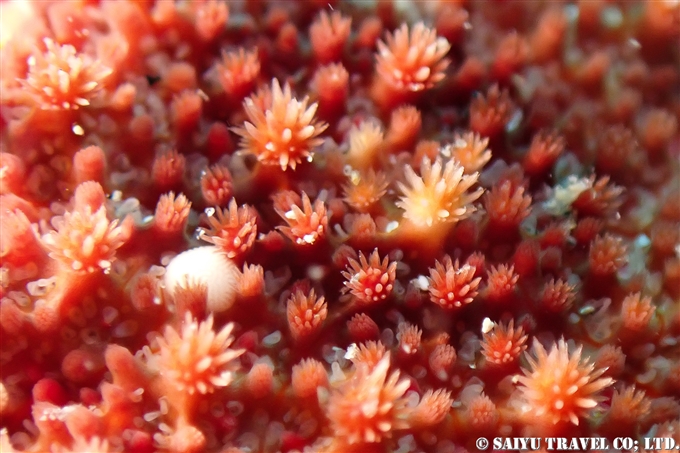
When you take a macro shot, it looks like a flower garden.

The coastal area’s rock walls which are carved by the waves, are a treasure trove for macro photography.

The kelp was a bit wilted, but the coral and kelp were beautiful.

Unfortunately, I could not eat the sea urchin because fishing was prohibited from August 31st. I decided to revisit Shakotan again in the future.

Image & Text: Mariko SAWADA
Observation: Sep 2022、Shakotan, Hokkaido

*Contact  us, Saiyu Travel for more information about wildlife and bird watching in Hokkaido. We can make various arrangements for your trip. We have a guesthouse, Shiretoko Serai, in Rausu, Shiretoko Peninsula.

Tags: , , , , , , , , , ,

From Japanese Bullhead Sharks to Dragon Moray Eels! Diving in Isu Oshima

At the start of July, we were in the waters around Izu Oshima. We could see Bullhead sharks, Dragon Moray Eels, and Hammerheads…We were there only for 2 days and one night but its only 1.5 hours away using the high-speed boat from Takeshiba Pier in Tokyo.

After we arrived in the early morning at the island, we had 3 dives, then the next morning grabbing another 3 dives, including being able to see the Hammerhead shark with sunrise, by the time we were back on the boat for going back, we had an 6 amazing dives under our belts! Isu Oshima is simply awesome.

Sea of Izu Oshima・The Undersea Geopark(1)

Sea of Izu Oshima・The Undersea Geopark(2)

Youtube : Dive in Izu Oshima

I was quite worried about the heat during the day, but the water temperature was 19 to 22 degrees ℃ which was fine in a dry suit. While taking a diving short course, we could observe so many fish, and on top of that, get some photos as well. The most memorable thing about the trip was our encounter with the Bullhead sharks.

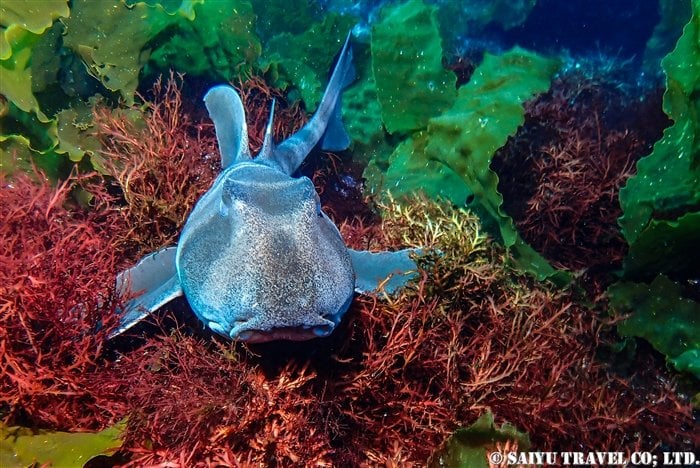
The Bullheads are quiet-natured sharks, who often live in the seaweed beds. They are commonly seen in Izu while diving. The English name is ‘Bullhead Shark’ but the Japanese name of the sharks are “Neko-zame” which means “Cat (neko) + Shark (same).” It is named this because where the eyes of the shark are pointy like a cat’s ears at the top of the head, the overall shape makes the shark look like a cat’s face.

トラウツボ Doragon Moray 伊豆大島 Izu-oshima

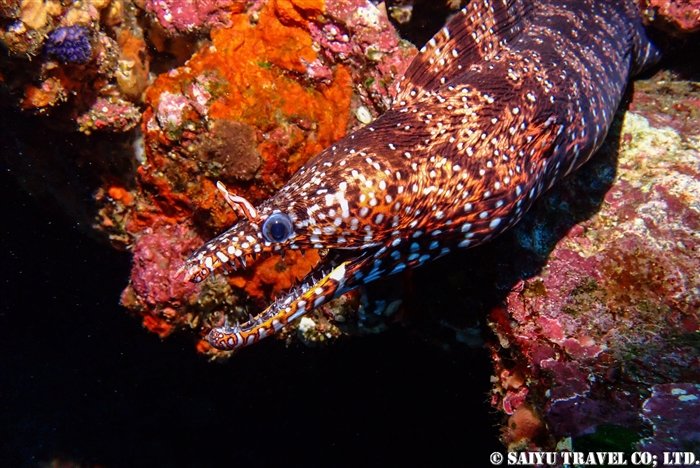
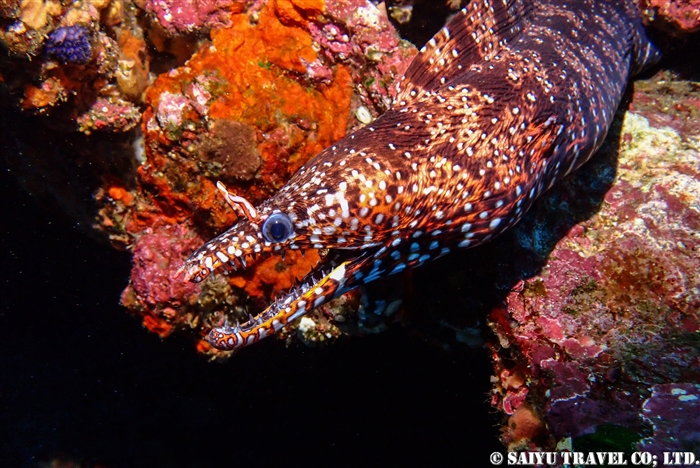
The Dragon Moray Eel.

The English name was ‘Dragon Moray’ but the Japanese named it as ‘Torautsubo’ or a ‘Tiger’ (tora) +’Moray’ (utsubo).

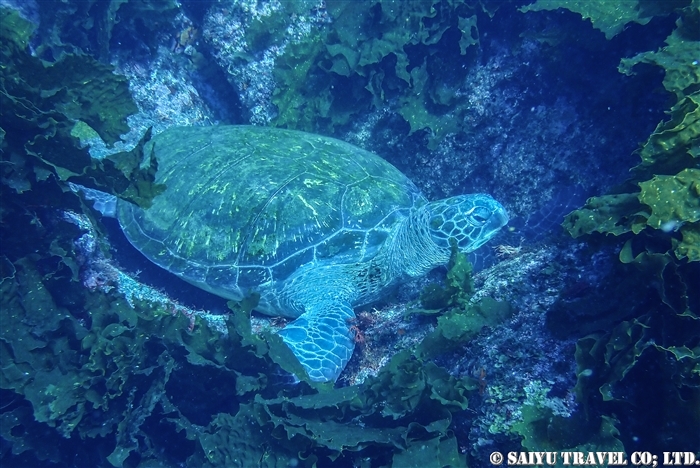
This Green Sea Turtle has been given a name by the locals as ‘The Lord’ (Nushi) because it is so extremely large. Because it is not photographed with a person, it is hard to get the scale of just how big he is, but in all the diving I have done, it is the largest Green that I have ever seen. According to our guide, either he is getting too old or too big, but he just does not move very much from this spot.

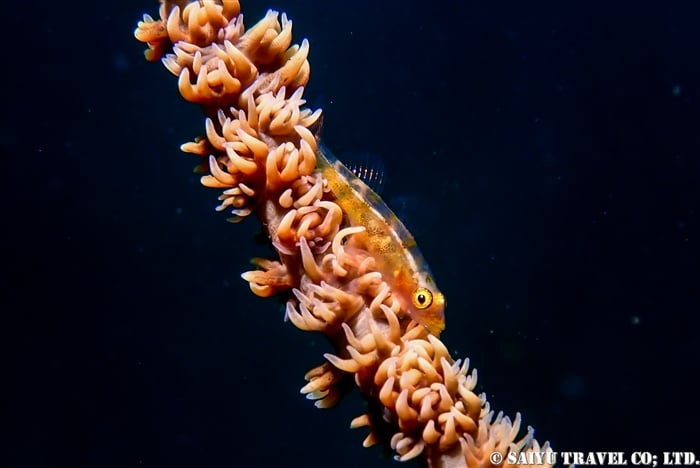
Whip Coral Goby

This type of coral is called a Whip Coral and the fish that lives on it is a type of Goby fish.

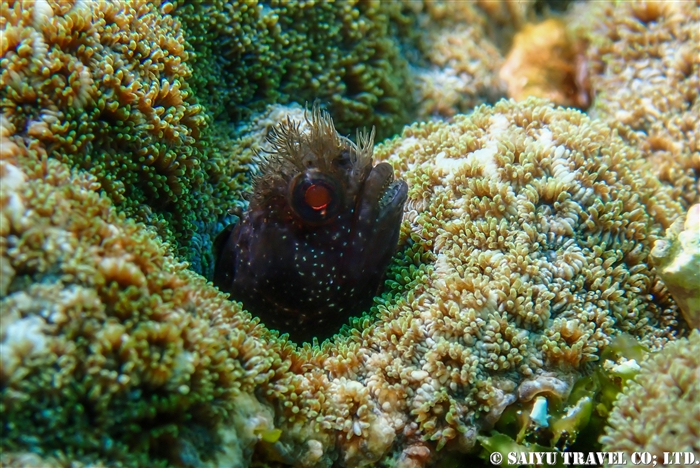
In Japanese this fish is called a ‘Toshima Gimpo’ (Neoclinus toshimaensis). It is poking its head out of its burrow but only 1cm of it can be seen.

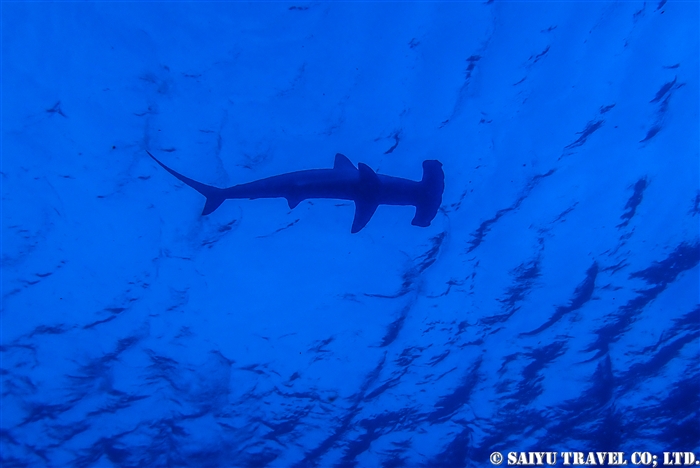
A Hammerhead shark at Keikai Beach. During this trip, we did not see that many of them, but it is always a little startling to see them swimming (we were at 12 meters depth as they passed directly overhead).

ツバメの巣立ち

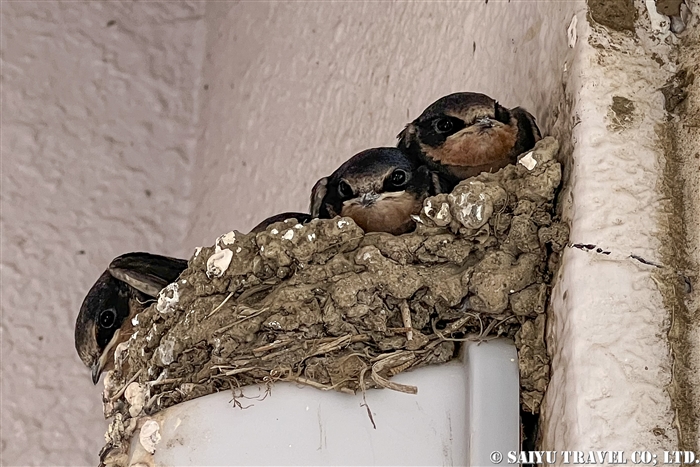
Near the access to our diving area, there is a toilet which served as the home for this Pacific Swift nest- it was full. The next day, the babies had fledged and left the nest.

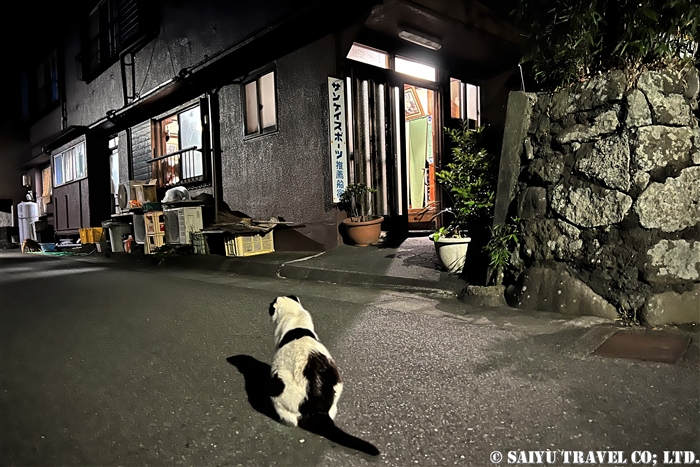
This is the outside of the lodging. There are many cats in this area. It was a very healing stay with nostalgic scenes like this and the friendly cats.

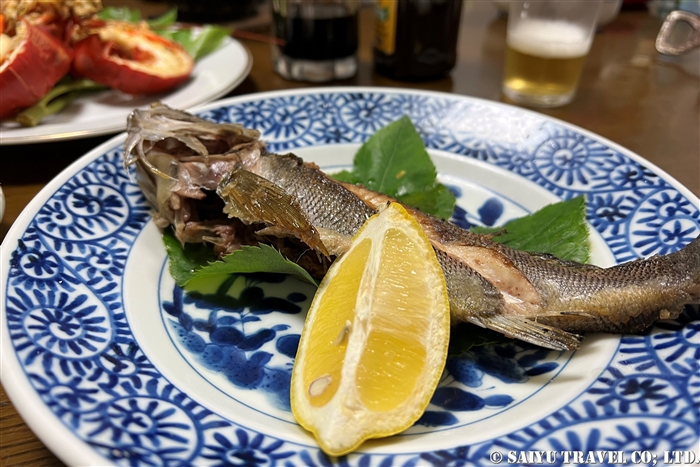
The fish we saw the most during this trip was the Chicken grunt (isaki). We also saw it on the menu at dinnertime!

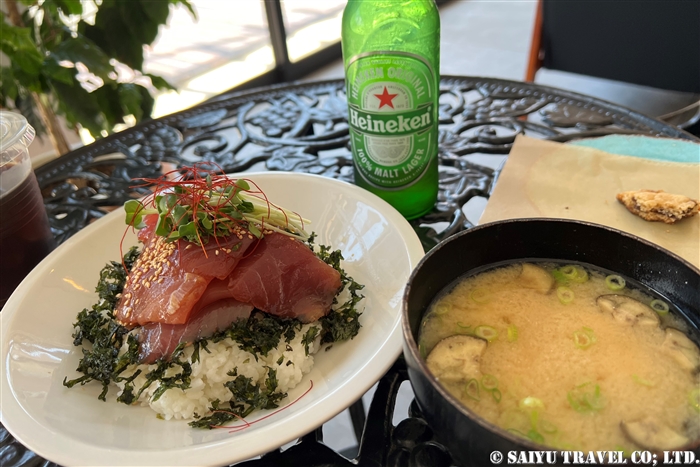
If you are in Izu Oshima, you should try the bekko rice bowl (Bekkou don). We ate it as our last meal after the final dive, enjoying all the specialty items the island has to offer. There is a pickled sashimi that is placed on top of the sushi rice. And the beer after having a dive tastes so good.

In the evening, we took the ferry back to Takeshiba pier in Tokyo.

Image: Mariko SAWADA
Observation: JUL 2022, IZU OSHIMA
Special Thanks: Beach Line

Related topic       Youtube : Dive in Izu Oshima

Tags: , , , , , , , ,